Follow @syymmetries
Showing posts with label Ceres. Show all posts

Saturday, 12 September 2015

Friday wrap-up: XMASS, multi-component dark matter...

Wherein I list some (mostly) recent happenings, ramble a bit, and provide links, in an order roughly determined by importance and relevance to particle physics. Views are my own. Content very definitely skewed by my own leanings and by papers getting coverage, and it may not even be correct. It is a blog after all...

  • The XIV International Conference on Topics in Astroparticle and Underground Physics (TAUP 2015) conference has been happening this week (hashtag here). The plenary talks are available but unfortunately a very many interesting parallel sessions are inaccessible...
  • One of those parallel sessions included a preliminary new result of the search for an annual modulation signal at XMASS. A summary and some plots can be found in this document [pdf]. They see "a weak modulation effect" which they say can be explained by a modest fluctuation background fluctuation, i.e., not significant results. Such are the difficulties in searching for annual modulation in only ~1.5yrs of data. No quote of the phase, but the fit for the modulation in their Figure 1 (below) has a negative amplitude, which might suggest that the best fit phase is ~6 months displaced from the standard halo model maximum in June... anyone have more information?


  • Robert Foot here in Melbourne maintains that it is still possible that dark matter could be the explanation for annual modulation signals seen by DAMA/LIBRA, CoGeNT, and recently by XENON100 (and now perhaps XMASS?). He posted to the arXiv last week outlining a scenario...

    The possible explanation is predicated on a dark matter halo made up of a pressure supported multi-component self-interacting plasma. Considering the mirror dark matter model for definiteness, the halo is mostly made up of dark electrons and dark He ions. There is a (massless) dark photon which mixes with the SM photon, imbuing the dark matter with dark charge and SM nanocharge. Far from the Earth the plasma is in thermal equilibrium; turns out this naively implies a ~100 times larger flux of dark electrons incident on the Earth than dark He. However, dark matter will be captured within the Earth, and by contradiction one can argue that dark electromagnetic fields must arise to equilibrate the (charge weighted) flux of dark electrons and dark He. The flux of the dark electrons on the Earth's surface, which can be possibly detected in direct detection experiments via single electron scattering, then depends on the details of these dark fields, which are assumed to arise from bulk movement of the charged dark matter on/near the surface of the captured dark matter sphere. Since the flux annually modulates due to the motion of the Earth relative to the halo, then so will these dark fields, and so will the electron flux incident on the Earth's surface. Needless to say, determining the flux is a very thorny dynamical problem... the preprint presents a "somewhat primitive" analysis to show in principal that such physics can give a large annual modulation fraction (which is a function of latitude). The "smoking gun" (and the make-or-break) for this scenario is a large diurnal (daily) modulation.

    This just goes to highlight the obvious fact that direct detection results are not as simple as comparing exclusion curves in spin-independent nucleon scattering cross section versus mass.
  • Further on the direct detection front, Lateral Mag have a story on the dark matter direct detection project getting underway here in Australia, in the Stawell Underground Physics Laboratory (SUPL). Funding for the lab has been obtained, and construction should start early next year!
  • On this blog:
    • I have updated my thoughts on the hierarchy/naturalness problem from a month ago. I wanted to distinguish between a hierarchy problem and a naturalness problem; it is my opinion that these terms are used too loosely in modern hep parlance (and perhaps people have different definitions anyway), and this causes confusion (especially from the point of view of an impressionable PhD student). So...

      At least to me, the following definitions make sense: a hierarchy problem is an unexplained hierarchy of scales within a model, and; a naturalness problem (for a mass parameter) arises when a scale receives very large and physically meaningful quantum corrections. The SM+gravity suffers a hierarchy problem by definition, but it is not clear to me that this implies a naturalness problem for the electroweak scale. That is what I blogged about a month ago. Actually, taken this way, minimal supersymmetry alone doesn't solve the hierarchy problem (i.e. it has a mu problem). Nevertheless (and if it arises at the TeV scale) supersymmetry ensures that the electroweak scale does not have a naturalness problem whatever the theory of gravity, and whatever scales are introduced in between (such as a GUT scale), which is in my opinion a very nice property and an admirable achievement for such models.
    • Playing with google charts recently I added a geomap and new/returning pageview charts using google analytics tracking, the google analytics superproxy, and a little javascript withquerying. They're a little messy right now but the information is there; the blog is getting >500 views a week now, so thanks for reading!
  • News from space...
    • A detailed image of the bright spot on Ceres...


    • ... and incredible new images of Pluto and Charon!


Friday, 28 August 2015

Friday wrap-up: 3.5 keV line, SUSY2015, Hawking...

Wherein I list some (mostly) recent happenings, ramble a bit, and provide links, in an order roughly determined by importance and relevance to particle physics. Views are my own. Content very definitely skewed by my own leanings and by papers getting coverage, and it may not even be correct. It is a blog after all...

  • The 23rd International Conference on Supersymmetry and Unification of Fundamental Interactions (SUSY2015; indico; hashtag) and 4th International Conference on New Frontiers in Physics (ICNFP2015; indico; hashtag) have been going this week.
  • Links without thinks:
    • Strangely Familiar: dark matter as many-quark states, from Sabine Hossenfelder and Naomi Lubick via New Scientist.
    • The current issue of Scientific American is a special issue on Einstein. [You should be able to access the articles through a University subscription].

Friday, 15 May 2015

Friday wrap-up: IBL, SABRE...

Wherein I list some (mostly) recent happenings, ramble a bit, and provide links, in an order roughly determined by importance and relevance to particle physics. Views are my own. Content very definitely skewed by my own leanings and by papers getting coverage, and it may not even be correct. It is a blog after all...

  • ATLAS News had a wrap-up of the 900 GeV collisions performed last week. It was cool to see an event display with the insertable B-layer in action (the fourth and most inner layer of the pixel layers on the right insert):


  • The Stawell Underground Physics Laboratory project here in Australia has received $1.75 mil from the federal government to match the State's contribution from earlier this year. The funding will go a significant way to constructing the clean room to host SABRE, the first southern hemisphere dark matter direct-detection experiment, the advantages of which I've mentioned earlier.
  • If the dark matter distribution in M87 is spiked at the centre, then this arXiv preprint claims that thermal relic dark matter is ruled out for an unprecedented $m_{DM}\lesssim 100$ TeV! As well, an apparent excess at high energies can be explained by $\mathcal{O}(1-100)$ TeV dark matter. I wonder if this paper will become another galactic centre excess for hep-ph?
  • The result has been on the arXiv for a while, but the CMS+LHCb $B_s (B^0)\to \mu^+\mu^-$ analysis was published in Nature, which I thought was interesting enough to note. As far as I can tell from a quick Inspire search, this is the first paper from the LHC Collaborations published in Nature. Note the 6 months from receipt to publication...
  • A few very interesting articles this week:
    • Nautilus: the story behind the OPERA superluminal neutrinos.
    • Aeon: on the pervasiveness and apparent non-falsifiability of inflation.
    • Scientific American: on physicists as philosophers.
    • Quanta: ultra-high energy cosmic rays, the Oh-My-God particle, and an EeV+ hotspot in the sky.
  • In video/audio media:
    • New physics frontiers at the 13 TeV LHC from CERN. [3 minutes]
    • A first video spot at Quanta Magazine: In Theory with David Kaplan (of Particle Fever fame) on what happens if you fall into a black hole. [2 minutes]
    • And if you'd like to learn more about the man responsible for backing the foundation that supports Quanta Magazine in the first place (and for Chern-Simons forms, and for Renaissance Technologies), you should watch the very interesting interview with James Harris Simons at Numberphile. [19 minutes]
    • Stephen Hawking on intelligence. [15 minute talk]
    • Excellent video at SmarterEveryday on how the window shutters on the space station work. [8 minutes]
  • Finally, updates on space missions: 
    • New Horizons can now make out all of Pluto's known moons.

    • The bright spots on Ceres we've been following now appear to be deposits of ice at the bottom of a crater.


Saturday, 25 April 2015

Friday wrap-up: SHiP, portals...

Wherein I list some (mostly) recent happenings, ramble a bit, and provide links, in an order roughly determined by importance and relevance to particle physics. Views are my own. Content very definitely skewed by my own leanings and by papers getting coverage, and it may not even be correct. It is a blog after all...

  • The SHiP fixed target experiment has uploaded its 200+ page physics case to the arXiv. Working at the intensity frontier, fixed target experiments collide very many (in this case) protons on a heavy target, with a detector placed some distance away after a significant amount of shielding. Because of the sheer number of protons on target, the setup is particularly sensitive to any ≲GeV scale extremely weakly interacting particles (large number × small number = detectable number!). The document is very comprehensive and speaks for itself; evidently the experiment has the capacity to explore some very interesting new physics scenarios, for example...

    If one modestly extends the standard model with a vector or a scalar field, it is always possible to write down gauge-invariant operators$$\epsilon F^{\mu\nu}F'^{\mu\nu},\\ \xi\phi^\dagger\phi S^2,$$where $F'^{\mu\nu}$ is a dark field strength operator and $S$ is a real singlet scalar. These are known as portal operators, and in the limit of very small $\epsilon$ or $\xi$ (which restores an enhanced Poincare symmetry and is therefore technically natural) the new states (referred to often as the dark photon and dark Higgs) are very long-lived and very weakly coupled to standard model states, so that they could still have gone undetected even if their masses are sub-GeV. If dark matter couples directly to these new states then they provide a "portal" from the standard model to the dark sector.

    So I was very interested to see the reach of the proposed experiment with respect to those portals; that reach is shown below as a function of mass for the case without dark matter, or with $m_{DM}>m_{A},m_S$ (the g* in the singlet case is proportional to the $\xi$ parameter above)...


    It is evident that the experiment would explore a significant amount of unexplored (not grey) parameter space (and the results are even stronger for a pseudoscalar). For the dark scalar case, the reach of the experiment comes from the unprecedented (in a fixed target experiment) number of B mesons produced, which can then subsequently decay to the light scalar state at a rate of one in a million or so. The states then live long enough to travel through the (~70m of) shielding before decaying in the detector.

    It is of note that unfortunately the widths and branching ratios of the scalar in the region $2m_\pi < m_S \lesssim 4$ GeV have large hadronic uncertainties, and the plot above must assume one theoretical prediction, so the story is not as clear-cut as it seems; luckily the experiment would be sensitive to many final states, and this goes some way to making the reach independent of this uncertainty. (These uncertainties do not exist for the dark photon thanks to measurements of our very own photon!). The most recent theoretical calculation for the dark scalar widths in this region is >20 years old. I wonder if lattice QCD could have something to say if it was applied to the problem?
  • Scientific American has an article on self-interacting dark matter on the back of the Abell 3827 cluster "hint" from last week.
  • And now that we have warmed up with Hubble here are some photos from the week...

Saturday, 18 April 2015

Friday wrap-up: 6.5 TeV, AMS, young pulsars, dark matter...

Wherein I list some (mostly) recent happenings, ramble a bit, and provide links, in an order roughly determined by importance and relevance to particle physics. Views are my own. Content very definitely skewed by my own leanings and by papers getting coverage, and it may not even be correct. It is a blog after all...

  • On this day last week we had the first 6.5 TeV beam fly around the LHC, and a day later we had both beams at once. You can read a little more at symmetry magazine.


  • AMS have presented their results on the cosmic ray proton/helium/lithium flux and the antiproton-proton ratio at a CERN mini-conference. Recordings of the talks are here and slides here. The press release is here. The plot they are pushing is the following one:

    Figure 1. Antiproton to proton ratio measured by AMS. As seen, the measured ratio cannot be explained by existing models of secondary production.

    The claim in the press release is, "This behavior cannot be explained by secondary production of antiprotons from ordinary cosmic ray collisions," with the suggestion that a new primary source(s) may be needed. But Sam Ting made sure during his talk to emphasise that it cannot be explained by existing secondary production models, and when presenting this figure he noted that there are many secondary production models, but "this is the one we choose" -- I wonder why... (an aside: he also in the same talk referred to his $J/\psi$ particle first as $J$ and then as $\psi$ on the same slide!). The point is that these models are very uncertain and the claim in the press release is unfounded. Indeed, there was a preprint on hep-ph yesterday which had the following to say: "Our first and main result is that there is no unambiguous antiproton excess that can be identified in the first place, and thus, at this stage, no real need for primary sources of antiprotons. Within errors, secondary astrophysical production alone can account for the data." Their Figure 2:


    So, don't believe the hype.
  • There was an arXiv preprint on Wednesday suggesting that young pulsars can explain the galactic centre excess. Their money plot is the following comparison of the expected dark matter spectrum with that from a prototypical young pulsar (Geminga).


  • Spectroscopic measurements of Reticulum II (here, here, and here) confirm it is an ultra-faint dwarf galaxy. Recall from the Hooper paper on the observed gamma ray excess, "In order for this excess to be compatible with the lack of significant gamma-ray detections from other dwarf galaxies... Reticulum II must contain a high density of dark matter, corresponding to $J \gtrsim 10^{19.6}\text{ GeV}^2/\text{cm}^{-5}$." One the new preprints has the J-factor measured at $10^{18.8\pm0.6}\text{ GeV}^2/\text{cm}^{-5}$ within 0.2 degs, and $10^{18.9\pm0.6}\text{ GeV}^2/\text{cm}^{-5}$ within 0.5 degs, and another has it at $10^{19.5^{+1.0(+1.6)}_{−0.6(−1.3)}}\text{ GeV}^2/\text{cm}^{-5}$ within 0.5 degs. So measurements seem to be disfavouring a dark matter interpretation. Also, it is of note that there is a radio source (likely a blazar) located 0.1 degs from the Ret II location which could be responsible for excess gamma rays...
  • An arXiv preprint (press release here) has observed that, in a system of four colliding elliptical galaxies, "each of the central galaxies retains a dark matter halo, but that (at least) one of these is spatially offset from its stars." The abstract adds, "With such a small physical separation, it is difficult to definitively rule out astrophysical effects operating exclusively in dense cluster core environments – but if interpreted solely as evidence for self-interacting dark matter, this offset implies a cross-section $\sigma_{DM}/m \sim (1.7\pm0.7)\times10^{−4} \text{ cm}^2/\text{g}\times(t_{infall}/10^9\text{yrs})^{−2}$, where $t_{infall}$ is the infall duration."

    We should keep in mind that these limits are based on the assumption that the interaction is velocity-independent, which is not true of a low-mass mediator. I don't have anything illuminating to add, but I do find it interesting that the previous study of colliding galaxy clusters set an upper limit of $\sigma_{DM}/m < 0.47 \text{ cm}^2/\text{g}$, and this measurement is almost four orders of magnitude smaller! Are measurements of these kinds of systems that much more sensitive? Why doesn't this system set an even stronger upper limit?
  • The "Evidence for dark matter in the inner Milky Way" saga appears to have reached an end. Both the comment and the reply to comment were updated this week, with the former reproducing a plot from a 1988 paper which is "in essence, identical to that of Iocco et al," and the latter writing, "In our letter we made a claim based on a specific technical point: that current data are constraining enough to make the claim robust against statistical and systematic errors. We believe we have made this point clear with our letter and two replies, and we shall not continue the discussion on the arXiv."
  • The Dark Energy Survey has produced a dark matter map (arXiv here, nature article here) of part of our sky using graviational lensing. Below is a heat map showing the mass density along with locations of galaxy clusters superimposed as grey dots. The map supports the standard picture that dark matter drives large-scale structure formation.

    photo
  • The EPS HEPP prizes were given out this week; the main prize went to James D. Bjorken “for his prediction of scaling behaviour in the structure of the proton that led to a new understanding of the strong interaction”, and to Guido Altarelli, Yuri L. Dokshitzer, Lev Lipatov, and Giorgio Parisi “for developing a probabilistic field theory framework for the dynamics of quarks and gluons, enabling a quantitative understanding of high-energy collisions involving hadrons”.
  • Strassler has been tackling the issue of dark matter searches at the LHC this week. He has a blog post and a new article for the layman.
  • Paul Jackson has written a blog post for the ATLAS blog on CoEPP and our conference in February.
  • Our understanding of the particle zoo as a function of time at Scientific American.
  • Frank Wilczek has a new book coming out in July, "A Beautiful Question: Finding Nature’s Deep Design."
  • Lastly, space images...
    • The first colour image of Pluto (and Charon) from New Horizons:

    • And here is our first view of Ceres from Dawn's new address:

      Ceres' North Pole

Friday, 13 March 2015

Friday wrap-up: ATLAS on-Z excess, CMS kinematic edge, new dwarfs, dark matter annihilation...

Wherein I list some (mostly) recent happenings, ramble a bit, and provide links, in an order roughly determined by importance and relevance to particle physics. Views are my own. Content very definitely skewed by my own leanings and by papers getting coverage, and it may not even be correct. It is a blog after all...

  • ATLAS released a preprint yesterday (submitted to EPJC), Search for supersymmetry in events containing a same-flavour opposite-sign dilepton pair, jets, and large missing transverse momentum..., that is interesting for two reasons.

    1. Remember the 2.6σ kinematic edge excess that CMS observed in their similar analysis originally released as a PAS in August last year? If not then see Tommaso Dorigo or Collider Blog for a summary... or don't, since ATLAS don't see any hint of it!

    2. They call CMS's excess, and then they raise, with a 3.0σ excess in a different signal region (SR). So let's talk about that...

    The search is for an on-Z opposite-sign same-flavour (OSSF) lepton pair + jets + MET. They are motivated by a gravitino LSP SUSY scenario with pair-produced gluinos which decay via $\tilde g\to qq\tilde\chi_1^0, \tilde\chi_1^0\to Z\tilde G$ (though it seems to me like something as simple as a vector-like quark could also work). Anyway, after typical preselection and requiring two OSSF leptons (if more than two are present they take the leading leptons), they define the on-Z signal region as: $$81< m_{l^+l^-}/\text{GeV}<101, \\ n_{jets}\ge2, \\ E_T^{miss}>225\text{ GeV,} \\ H_T>600\text{ GeV,} \\ \Delta\phi(jet_{12},E_T^{miss}>0.4,$$where $H_T$ is the scalar sum of the jet and lepton $p_T$ in the event, and the $\Delta\phi$ cut is designed to reject background from mismeasured jets faking large $E_T^{miss}$. And backgrounds are tough... $Z/\gamma^*+jets$ with mismeasured jets producing difficult-to-model instrumental $E_T^{miss}$ is potentially worrisome, but it is made negligible by the $\Delta\phi$ cut. Flavour-symmetric backgrounds (with a truth-level flavour ratio $ee:\mu\mu:e\mu$ of 1:1:2) from $t\bar{t}$, $WW$, single top, and $Z\to\tau\tau$ are dominant; they are estimated with a data-driven method using opposite-flavour data as a control region. Fake leptons are estimated from data.  Diboson, $t\bar{t}V$, $t\bar{t}VV$, and $t+Z$ are estimated from MC, making sure not to double count the flavour-symmetric component.

    The expected and observed number of events as a function of invariant mass in the dielectron and dimuon channels are shown below:


    For the sum of both channels the expected background is 10.6±3.2 with 29 events observed, which ends up corresponding to a 3.0σ excess.

    Now, CMS did a similar search in the on-Z SR in their paper and didn't see anything. So are the results consistent? It's possible. The CMS SR wasn't quite as tight as the one employed by ATLAS. After similar preselection, for an on-Z signal region defined as $$81< m_{l^+l^-}/\text{GeV}<101, \\ n_{jets}\ge2, \\ E_T^{miss}>200\text{ GeV,}$$CMS have an expected background of $\approx$ 87.3±12.1 with 72 events observed. So who knows, maybe if CMS demanded $H_T>600$ GeV they would see something too, or maybe not... 
  • The biggest news of the week comes from Tuesday's astro-ph listings. This is not my area, so I can't comment intelligently, but anyone can read an abstract and look at Figures, so I will just sum up here for completeness and convenience (click the figures to make them larger)...

    1. Fermi-LAT released their Pass 8 constraints on dark matter annihilation (already largely known from preliminary results). They rule out dark matter masses $\lesssim 100$ GeV for a thermal relic annihilating to $b\bar{b}$ or $\tau\tau$. Those results are cutting into the best fit regions for the galactic centre excess.


    2. The Dark Energy Survey (DES) Collaboration has located eight new dwarf satellite galaxy candidates (of the Milky Way and/or Magellanic Clouds), and an independent Cambridge group has located nine using the publicly released DES deep photometry data. You can read the press release here.


    3. The new satellite candidates are prime spots to look for dark matter annihilation... so Fermi-LAT went and did it already! Assuming that the new candidates are dwarf spheroidals, they set a limit on the annihilation cross-section that rivals their Pass 8 results with known dwarfs above.


    4. But the story isn't over yet, because an independent group (which includes the Cambridge group that found nine candidates) has reported a gamma-ray excess, consistent with DM annihilation, in one of the new dwarf candidates. [Edit: The candidate is Reticulum II or DES J0335.6−5403, the green line in the above Fermi-LAT plot, which appears by eye to be the only line of all the candidates to have a weakened limit in the 10−few×100 GeV DM mass region, the region that would produce the excess.]


    And the dark matter annihilation saga continues...
  • Protons bunches half-circled the LHC beam pipe last weekend for the first time since the long shutdown began! Injector tests sent bunches from the SPS into the LHC ring and through ALICE and LHCb on their way to beam dumps. Both ALICE and LHCb recorded splash events when the beam was made to collide with a target.


    You can play with the LHCb event here. First fully circulating beam is expected at the end of the month.
  • PRL has published the Planck/BICEP2/Keck joint analysis, along with a Viewpoint article which tells some of the story -- we are reminded of the following: "... alternative models may be detectable with the next generation of experiments, some of which claim a sensitivity to r as small as 0.01. The competition is fierce, with at least six funded ground-based experiments underway (including the third version of BICEP), several balloon-borne experiments, and a number of proposed space missions."
  • There's a nice feature at ScienceNews about the AMS experiment, the positron excess, and Samuel Ting; on the (unreleased) preliminary antiproton data he remarks: "intriguing".
  • Published in Nature yesterday, the Cassini orbiter has detected tiny rock grains emitted from the plumes of the Saturnian moon Enceladus, hinting at a subsurface ocean. You can read the articles at NASA, ESA, or Scientific American. Meanwhile a team using Hubble have used observations of aurora to indirectly suggest that there is a subsurface ocean on Ganymede, Jupiter's largest moon. Nice to see that there are complementary ways to measure these things.
  • Today Rosetta is trying to listen for a signal from the Philae lander on Comet 67P/Churyumov-Gerasimenko. ESA released a cartoon video about it a few days ago [3 minutes]. The Lander Project Manager says, "It will probably still be too cold for the lander to wake up, but it is worth trying."

Friday, 6 March 2015

Friday wrap-up: Higgs LFV decays, Higgs width, dissipative DM and rotation curves...

Wherein I list some (mostly) recent happenings, ramble a bit, and provide links, in an order roughly determined by importance and relevance to particle physics. Views are my own. Content very definitely skewed by my own leanings and by papers getting coverage, and it may not even be correct. It is a blog after all...

  • CMS has submitted their paper on the search for LFV Higgs decays. This analysis supersedes the PAS from July (which has 20 citations). They see an excess of 2.4σ, which I wouldn't make much of, but it is worth keeping track of these "hints" because they motivate papers you see popping up on hep-ph. The following is a quick summary...

    They search in the $\mu\tau$ channel, which is experimentally the best channel in which you might hope to see something after taking into account bounds from LFV transitions. The best fit branching ratio for the excess corresponds to $Br(H\to \mu\tau)=0.84\%$, an order of magnitude below bounds from $\tau\to\mu\gamma$. The dominant backgrounds for the search are $Z\to\tau\tau$, $W+jets$, QCD multijets, and $t\bar{t}$. The latter three are certainlysome of the nastiest backgrounds around at the LHC. $W+jets$ in particular is responsible for a number of historical anomalies (see Tomasso's blog or his talk). Happily they can be estimated with the help of data in background-enriched regions, which is nice, but shape uncertainties must then be carefully considered as systematics. Anyway, let us move on to the results...


    The left and right columns correspond to the leptonic and hadronic $\tau$ decay channels respectively, and each row corresponds to an increasing number of jets (the last row is enhanced with VBF events). The variable they plot against is the collinear mass $M_{col}$, an estimator for the Higgs mass (in the signal events) constructed by assuming the neutrino (coming from the $\tau$ decay) momentum is equal to the projection of the missing momentum vector onto the direction of the $\tau$ decay products. The distributions driving the excess are $\mu\tau_e\;0$-jet, $\mu\tau_e\;1$-jet, and $\mu\tau_h\;2$-jet. That can be seen by eye above and in the branching fits themselves:


    One would assume (or hope?) that the ATLAS analysis is underway, and certainly it will be interesting to find out what they see.
  • ATLAS has bounded the Higgs width at < 22.7 MeV at 95% CL (SM is 4.1 MeV) using the off-shell $gg\to VV$ Higgs boson signal, with assumptions (see below)! This supersedes their Conf Note from July and adds the WW channel to the analysis. The idea of doing this measurement (as far as I know) is based on the paper from Caola/Melnikov (1307). CMS managed to do the analysis and present it as a prepublication within 6 months of that paper (a phenomenal effort), rushed out for Moriond [pdf], and later published (in September) a bound of < 22 MeV at 95% CL [it should be noted that in the present ATLAS analysis the CLs method has been used which weakens their upper bound in the presence of the observed downward fluctuation of the low-statistics background; CMS used the regular $-2\ln L<4$ method and if ATLAS had done the same, judging by their Figure 12, their bound would rather be < 16.4 MeV]. The CMS result was presented as having "mild model-dependence," but not long after the bound was shown to be invalid for general new physics scenarios without some specific assumptions (see e.g. Englert/Spannowsky 1405). ATLAS appear to have specified clearly the assumptions going into their analysis...

    The ratio of the off-shell to on-shell g-g fusion signal strength is $$\frac{\mu_{\text{off-shell}}(\hat{s})}{\mu_{\text{on-shell}}}=\frac{\kappa^2_{g,\text{off-shell}}(\hat{s})\kappa^2_{V,\text{off-shell}}(\hat{s})}{\kappa^2_{g,\text{on-shell}}\kappa^2_{V,\text{on-shell}}}\frac{\Gamma_H}{\Gamma_H^{SM}},$$where the $\kappa$ are coupling scale factors of the Higgs to $gg$ and $VV$. The approximation CMS made was that the ratio of $\kappa$'s was equal to unity. ATLAS sets their limit under the assumption $$\kappa_{g,\text{on-shell}}^2\kappa_{V,\text{on-shell}}^2\le \kappa_{g,\text{off-shell}}^2\kappa_{V,\text{off-shell}}^2 .$$They also assume that none of any new physics which might alter the Higgs width changes substantially the background (of particular interest in this case since the off-shell signal and continuum background destructively interfere). The higher-order QCD corrections for the continuum background are not available, so in presenting their results they allow this K-factor to vary by a factor of 2 around that calculated for the SM Higgs.

    I find this measurement interesting as an independent way to probe the Higgs width. In principle it is possible to increase the Higgs width to > 22 MeV and have it consistent with all measurements, but it involves scaling up SM couplings while adding a new decay mode to keep the production×decay rate fixed. The global Higgs fit means that the upper bound on the Higgs branching to unobserved (not necessarily invisible) decays is < 21% for an otherwise SM Higgs
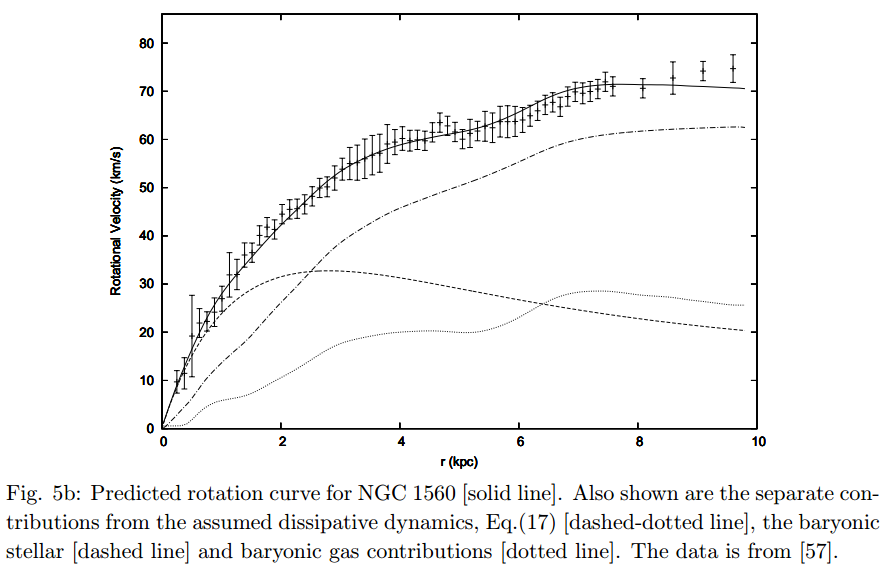
  • An arXiv preprint has shown that a one-parameter generic dissipative dark matter model with supernovae heat source can explain the 'wiggles' in rotation curve data. Assuming that DM cooling is balanced by this heating mechanism and the DM density is in a stable state, it is shown that the density of DM is related to the supernovae formation rate in the disk. If the SN rate is related to the gas density via a Kennicutt-Schmidt law, then the DM density is connected to the baryonic gas density in the disk: $$\rho(r,\theta)=\tilde\lambda \int d\tilde\phi \int d\tilde r \tilde r \frac{[\Sigma_{gas}(\tilde r)]^N}{4\pi[r^2+\tilde r^2-2 r \tilde r \sin\theta\cos\tilde\phi]},$$where $N\approx 2$, and $\tilde\lambda$ is an appropriately averaged quantity which depends on the cross section, supernovae dark photon energy spectrum etc.

    You can now go out and apply this equation to gas density measurements and predict the rotation curve up to the constant $\tilde\lambda$. This was done for the spiral galaxy NGC1560 (below):


    There are more examples in the paper, fitting to dwarf galaxies from the LITTLE THINGS survey released last month. Reasonably good fits are obtained, especially considering it is only a one-parameter model; the best fit values of $\tilde\lambda$ vary only within a factor of two.
  • The PICO-2L C3F8 Bubble Chamber in SNOLAB have reported the most sensitive direct detection constraints on WIMP-proton spin-dependent scattering to date. Below is a plot which compares various limits.


    The limits which appear to "beat" PICO-2L come along with some assumptions: IceCube, ANTARES, and SuperK are neutrino telescopes looking for annihilating dark matter in the sun; CMS/ATLAS search for mono-X signatures and assume an effective field theory (valid if the mediator mass is $\gg\sqrt{\hat{s}}$). In the conclusion they claim "These limits represent... the first time supersymmetric parameter space has been probed by direct detection in the SD-proton channel." Can't help but doubt this...
  • The Neutrino Telescopes conference (NeuTel XVI) is well under way and is keeping a blog here which contains summaries of talks and posters. I really like this method for gathering in one place succinctly and accessibly the important information; of course one can still access the full talks to find out more.

    Here is one interesting post from Francesco Iachello. He claims that quoted neutrinoless double beta decay bounds are too strong by a factor 2.5--6 due to the overestimate of a nuclear matrix element factor. This would mean that the inverted hierarchy region still allowed by Planck cannot be probed by $0\nu2\beta$ experiments in near future.
  • There is an interview with Jamie Bock of the BICEP2 experiment at Sean Carroll's blog. Here is an excerpt on the decision to release results when they did: The question really is, should we have waited until better data were available on galactic dust? Personally, I think we did the right thing. The field needed to be able to react to our data and test the results independently, as we did in our collaboration with Planck. This process hasn’t ended; it will continue with new data. Also, the searches for inflationary gravitational waves are influenced by these findings, and it is clear that all of the experiments in the field need to focus more resources on measuring the galaxy.
  • Twenty years ago on Tuesday was the discovery of the top quark at Tevatron. The papers of CDF and D0 were released together and can be read for free at PRL Milestones. Top at Twenty at Fermilab is celebrating this milestone from 9-10 April, in the traditional way of particle physicists: talks! Reviews of fundamental measurements of the top quark, measurements of top quark production and decay, theoretical talks on how the top quark fits into the Standard Model and its potential extensions, etc...
  • I don't know how significant this tweet from today is, but perhaps something to be aware of... [Edit: never mind, must have been minor (see second tweet)]

    • A paper published yesterday in Science has measured the D/H enrichment of atmospheric water on Mars. They found a D/H value enriched by a factor of about 7 relative to Earth’s ocean, which indicates that Mars has lost most of its water to space -- about six times the amount presently locked up in the Martian ice caps. This implies that Mars once had an ocean covering 20% of the planet's surface, up to one mile deep, and was wet for >1.5 billion years. Plenty of time for life! There's a 4 minute video about it from NASA Goddard, or an article at the guardian if you prefer.
    • Another paper in Science reports the observation of a gravitationally lensed supernova forming an Einstein cross. Because of the different travel times for light rays taking different paths around the lensing cluster, it is suspected that the supernova explosion would have appeared before (1964 and 1995) in another part of the sky, and will appear again elsewhere some time before 2020. There's an NY Times article here with a video.
    • Here is Rolf Heuer on the European Commission's decision to divert €2.7 billion (4%) of the EU’s science funding programme, Horizon 2020, to alternative investments.
    • Not sure what to think of the following tweet from Murdoch, but with The Australian's recent flip-flopping on Abbott who knows...
    • If you aren't already following Sabine Hossenfelder blogging at BackReaction, you should. Two more interesting pieces from her this week: 1) Are pop star scientists bad for science? 2) Can we prove the quantization of gravity with the Casimir effect? Probably not.
    • Very many articles knocking around this week about Homer Simpson predicting the Higgs boson mass, apparently relating to Simon Singh's new(ish) book on Mathematics and The Simpsons. Actually, you can now read that chapter for free here.


      If you actually calculate it you find it to be $\approx 775$ GeV. Not so miraculous. Change the $\pi$ to a $\frac12$ and he does a lot better, but since we know that the Higgs mass is just a conspiracy of gravity, QCD, and the weak force, maybe he should have guessed $$ \approx \pi\left(\frac{m_p}{2m_W}\right)^8\sqrt{\frac{hc}{G}}, $$ at tree level of course.

    Friday, 27 February 2015

    Friday wrap-up: leptogenesis, displaced vertices, mass extinctions, data scraping...

    Wherein I list some (mostly) recent happenings, ramble a bit, and provide links, in an order roughly determined by importance and relevance to particle physics.
    • Doing the rounds lately has been a new mechanism for leptogenesis: (post-inflationary) Higgs relaxation leptogenesis. APS has a synopsis and Scientific American has a story (never let difficult physics stop a title containing both "Higgs" and "antimatter"). Kusenko, Pearce and Yang achieve the observed matter-antimatter asymmetry using this mechanism in only the minimal Type I see-saw model. The Type I see-saw is a very nice model for neutrino masses, and it can explain leptogenesis via the Fukugita-Yanagida mechanism (1986), but it is not possible to do both without ceding naturalness. For me, this provokes an interesting question: is there any way of doing natural leptogenesis in the Type I see-saw without adding new particles? The only ways I am aware of are resonant leptogenesis and neutrino oscillations. This could be another (and would be a nice selling point for the mechanism) if it can work with $M_N\lesssim 10^7$ GeV... but this requires further thought and investigation; in the examples they give (Figure 2) the right-handed neutrinos are much heavier than this requirement.
    • Tom Kibble's recollections on the history of electroweak symmetry breaking are online. I don't think there is anything in there that is particularly new, but it is a nice short document written at an accessible level. Here is an excerpt on the three-year gap between the Higgs mechanism and the electroweak theory:

      The 1964 papers [on avoiding the Goldstone theorem] from the three groups attracted very little attention at the time. Talks on the subject were often greeted with scepticism. By the end of that year, the mechanism was known, and Glashow’s (and Salam and Ward’s) SU(2)×U(1) model was known. But, surprisingly perhaps, it still took three more years for anyone to put the two together. This may have been in part at least because many of us were still thinking primarily of a gauge theory of strong interactions, not weak... A unified gauge theory of weak and electromagnetic interactions of leptons was first proposed by Weinberg later that year. Essentially the same model was presented independently by Salam in lectures he gave at Imperial College in the autumn of 1967 — he called it the electroweak theory... Weinberg and Salam both speculated that their theory was renormalizable, but they could not prove it... Renormalizability was finally proved by a young student, Gerard ’t Hooft, in 1971, a real tour de force using methods developed by his supervisor, Martinus Veltman.
    • I'm seeing a bunch of articles linking mass extinctions to disk dark matter again this week. The origin appears to be a press release from NYU on a paper by a Professor of Biology who appears to be an expert in extinction events. You can read it in full for free here. The paper, which is in a monthly notices journal, seems to me to be largely a review, perhaps with the new suggestion of linking the work of Abbas-Abbas on clumpy dark matter capture causing large-scale volcanism with the Randall-Reece disk dark matter scenario to explain the ~35 Myr period in mass-extinction events. For that reason it is disappointing to not see any reference to those authors in the press release or the related articles circling around. Maybe as a consolation, given the buzz around those articles, it is clear that Randall's new book should sell by title alone!
    • A new arXiv preprint shows that in elliptical galaxies, the central stellar velocity dispersion (a surrogate for the central black hole mass) is more tightly correlated to the total gravitating mass of the galaxy rather than the stellar mass, connecting central black holes of elliptical galaxies with their dark matter halo.
    • A separate preprint has observed nearly-spherical streams of ionized gas winds coming from an active central black hole. Bad Astronomy has a nice article about it. The winds transfer energy into the galaxy well beyond the gravitational influence of the black hole, affecting the galaxy's evolution.
    • I learned this week that it is actually fairly easy to extract data from a vector plot. This is a common task for the phenomenologist so I will explain two examples below for reference, since I haven't seen it written anywhere in detail; skip this point if you're not interested.

      Usually, if I need to scrape a plot (often exclusion curves) I just use WebPlotDigitizer, however there are some plots with many points or indiscernible lines which are not amenable to that method. For example, the BaBar limit on dark photons is a nightmare:


      But it is a vector plot, so in principle it should be possible to extract the information on how to draw the curve. Here is one way...

      First save the page of the .pdf as an .svg file (I used inkscape). When you open the .svg file in a text editor you will find some intuitive syntax describing how to draw the plot. We want to pick out the BaBar line, so I looked for an occurrence of stroke:#000000 (a black line) associated with a list of numbers. If you do this yourself you will find those numbers in the following context inside a "path" element:

      d="m 146.558,372.935 0.639,-122.326 1.668,4.96 1.625,1.169 ...

      According to the syntax, in general a path element contains a d="(path data)" attribute, where the ‘d’ attribute contains the moveto, line, curve (both cubic and quadratic Béziers), arc and closepath instructions. In the above case we have a lower case m which indicates relative moveto's which will draw the line of interest. To get the points then we just have to transcribe the list into our favourite format and write a for-do loop (or similar) to obtain absolute positions.

      In Mathematica, this can be done by replacing spaces with "},{" and adding opening and closing brackets to obtain the list:

      pts={{146.558, 372.935},{0.639, -122.326},{1.668, 4.96},{1.625, 1.169},...

      Then the for-do loop is just

      Lpts=Length[pts];
      relpts=pts;
      Do[
        relpts[[i]]=relpts[[i-1]]+relpts[[i]]
      ,{i,2,Lpts}]


      Which upon plotting looks like the following:


      Now all you have to do is rescale your axes!

      Another example is Fig. 3 of the recent BaBar long-lived particle search:


      After saving as a .svg, you will see that the plots are made up of many (many) points. Say you wanted all the cyan points. Each point appears as its own path object in the file like so:

      ...
               style="fill:#00ffff;fill-opacity:1;fill-rule:evenodd;stroke:none" /><path
               d="m 1087.05,7047.46 c 0,1.66 -1.35,3 -3.01,3 -1.65,0 -3,-1.34 -3,-3 0,-1.66 1.35,-3 3,-3 1.66,0 3.01,1.34 3.01,3"
               id="path16732"
               style="fill:#00ffff;fill-opacity:1;fill-rule:evenodd;stroke:none" /><path
               d="m 1085.84,7048.66 c 0,1.66 -1.34,3 -3,3 -1.65,0 -3,-1.34 -3,-3 0,-1.65 1.35,-3 3,-3 1.66,0 3,1.35 3,3"

      ...


      All the points you want are the coordinates after the m. So you just need to get them somehow. There are no doubt multiple approaches to this. In bash you could grep or awk or sed your way there. For this example I used the command

      $ sed -n '/fill:#00ffff/{n;p;}' BaBar1502.svg > cyanpts.dat

      to print to file all the lines after a line with a match for fill:#00ffff. If you paste that document into a spreadsheet program you can then pick off the numbers of interest into columns.
    • In video media:
      • A promo video from CERN with some nice shots of the LHC experiment: The LHC is preparing to start. [2 minutes]
      • Here is a drone flying over the ALICE detector. [3 minutes]
      • I missed this talk by Dan Hooper from a few weeks ago. Some talk on the central excess is at 28-46 mins. There is also a fun anecdote about astrophysicist Troy Porter. [1 hour]
      • Katie Mack talking about Mars plumes, the star that passed through the Oort Cloud 70,000 years ago, the Europa Clipper mission, and Ceres on breakfast radio. Begins at 2:13. [9 minutes]
      • SmarterEveryday is starting a space series with a personal touch. In the first video astronaut Don Pettit shows how he turns off the streetlight at the end of his driveway with a laser so that he can better view the night sky. [4 minutes]
      • Mary Somerville, Alan Turing, and Stephen Hawking autographs in The Royal Society Charter Book at Objectivity. [5 minutes]
    • Interstellar's rapidly spinning black hole was slowed down for aesthetic reasons during rendering, to reduce the resulting brightness asymmetry and blueshift.

    • As we know, the arXiv surpassed $10^6$ papers last month and increased its article identifier sequence number to 5-digits to cope with the fact that they are nearing $10^4$ monthly submissions. Hot on arXiv's tail, now viXra has surpassed $10^4$ submissions! The real winner though is the snarxiv, with well over $\infty$ submissions...
    • The bright spot on Ceres is actually two bright spots! (Ceres is opening its other eye...)

    • This week we won't end on space images. Instead I reproduce a poem by Thomas Otto called "LHC" (I enjoyed the final stanza):

      I - LHC

      Cold
      Ice cold
      Arctic cold
      Nitrogen cold
      Argon cold
      Helium cold
      Colder than the cosmos:
      Superfluid Helium cold

      In the cold,
      Powerful currents
      Engender magnetic forces
      Ushering protons left and right.

      Protons travelling on the crests of ethereal waves
      Close to light speed
      100 billion at a time, a galaxy of protons.

      Wave after wave emerging from the cold
      Spilling galaxies into the void
      Galaxies of protons collide
      To re-create the origins.

      II - CMS

      A cylinder from glass and steel,
      A mythical animal hunched deep in its cave,
      Swallowing bunches of protons,
      Like a frog catching flies.

      Protons colliding, the debris on paths bent by magnetic forces
      Electrical signals through a network of cables
      The animal’s thoughts light up,
      A memory of the origins

      III - CERN

      Bright minds
      Tackling tough problems:
      Accuracy of the data,
      Beauty of the theory,
      And origins of the visible universe.

      Seasoned researchers,
      At ease with latest physical science:
      Handling strings and triggers,
      Seeing light in crystals,
      And integrating over 26 hidden dimensions.

      At lunchtime,
      A challenge like no other:
      Looking for a parking space,
      Queuing for a menu,
      And searching a place to put their meal tray.