Follow @syymmetries
Showing posts with label Mars. Show all posts

Saturday, 3 October 2015

Friday wrap-up: 1/fb, various links...

Wherein I list some (mostly) recent happenings, ramble a bit, and provide links, in an order roughly determined by importance and relevance to particle physics. Views are my own. Content very definitely skewed by my own leanings and by papers getting coverage, and it may not even be correct. It is a blog after all...

  • A huge amount of data was accumulated this week. ATLAS surpassed 1/fb of integrated luminosity, and at the time of this writing is sitting at >1.4/fb!


  • A rumour emerged last weekend of gravitational wave discovery at LIGO; there's a nature column claiming it is unlikely and/or just a drill.
  • The Quark Matter 2015 conference (indico; hashtag) was on this week.
  • The CMS Experiment has a new outreach initiative: CMS Voices on twitter, with a new CMS physicist every month.
  • Links without thinks:
    • Wall Street Journal: "China's Great Scientific Leap Forward," an opinion piece from Gross and Witten [behind a paywall but for me is accessible via a Google search].
    • Life and Physics by Jon Butterworth: "Fermilab's giant magnet begins its journey into the quantum badlands," on the muon $g-2$ experiment which began this week at Fermilab.
    • Nautilus: "The Trouble with Theories of Everything," from Lawrence Krauss.
    • Backreaction has been busy: "No, Loop Quantum Gravity has not been shown to violate the Holographic Principle," and "When string theorists are out of luck, will Loop Quantum Gravity come to rescue?"
    • Terence Tao has submitted a solution to the Erdős discrepancy problem, motivated by a suggestive comment on his blog; see articles at nature news, and Quanta.
  • In audio/video media:
  • Myriad awesome images emerged from NASA this week of "recurring slope lineae" on Mars, hypothesised to be formed by the flow of briny liquid water. See Emily Lakdawalla's blog for a scientist's take.


Friday, 8 May 2015

Friday wrap-up: Collisions, displaced Higgs decays...

Wherein I list some (mostly) recent happenings, ramble a bit, and provide links, in an order roughly determined by importance and relevance to particle physics. Views are my own. Content very definitely skewed by my own leanings and by papers getting coverage, and it may not even be correct. It is a blog after all...

  • The LHC has seen collisions at injection energy, 450 GeV per beam. There's a little more you can read at symmetry magazine; still plenty of calibration to be done. Here's one of the events in the ATLAS detector, a far cry from the messy environment we'll see at 13 TeV...


    As well, CMS has a visualisation of one of their events on YouTube.
  • Pheno 2015 happened this week in Pittsburgh. Definitely worth perusing the interesting talks on the indico page.
  • I uploaded an arXiv preprint on Monday, "Constraining portals with displaced Higgs decay searches at the LHC." One of the primary purposes of the LHC is to study the properties of the newly discovered Higgs boson in great detail. Even though we have now measured its mass to within ~0.2%, it is still possible that it is decaying to exotic particles 20% of the time! So it is clearly sensible to search for exotic Higgs decays. I concentrated on one possibility: the decay to a pair of long-lived particles which each subsequently decay around 1 metre from the beam pipe...

    Such long-lived particles are well-motivated; typically all you need is an approximate symmetry (which is by definition technically natural à la 't Hooft) in your model which if exact would result in a stable particle. This appears to be coming into vogue at the moment as we see natural SUSY being pushed into compressed and long-lived areas of parameter space; for example, if you violate R-parity just slightly then the would-be neutralino dark matter candidate can become long-lived. I became interested in this sort of phenomenology from a much simpler standard model (SM) extension: by a real singlet scalar field $S$. In that case you can write down a potential term $\zeta \phi^\dagger\phi S^2$ which mixes the Higgs boson and a new mass eigenstate $s$ after symmetry breaking. As $\zeta\to 0$ the $S$ field decouples from the SM and becomes stable, so for small $\zeta$ it is long-lived. It is possible that the $S$ also directly couples to some dark sector uncharged under the SM forces, so-called Higgs portal models. Anyway, the Higgs we know and love can decay to two $s$ particles which, in the simplest case, decay to SM particles somewhere in the middle of the detector. Else the $s$ could have some complex cascade decay into hidden sector states which subsequently decay in the middle of the detector (often called hidden valley models).

    You can do a similar thing with a massive dark photon, the so-called vector portal. In fact, the possibilities are many and varied, which presents two complementary challenges: how do collaborations present their results in the most model-independent way possible? and how do phenomenologists reinterpret the results in the context of their own models? The point of my paper was to explore these questions...

    So I had a go at reinterpreting two searches already performed by ATLAS, in a very simple way: by running Monte Carlo simulations, calculating decay probabilities, and folding in the provided particle reconstruction efficiencies as a function of the decay distance of the long-lived particles. As phenomenologists we are reliant upon these provided efficiencies, as there is no tool available to reliably calculate them ourselves. As we move on the journey which constitutes the bulk of the paper, we learn some valuable life lessons about what efficiency table information the collaborations could provide to make the life of phenomenologists wanting to reinterpret their searches (and there are a few of us out there!) much easier. Those life lessons are summarised in the conclusion.

    As well, at the end of the day I was able to make my own contribution to the portal model exclusion space, with the pretty pictures below...


  • There's an article at Nautilus on "The Admiral of the String Theory Wars" AKA Peter Woit. As might be intuited, the article describes the string theory wars around the time when Woit released his book, "Not Even Wrong." It touches on his arXiv trackback controversy and feud with Polchinski. (Also I learned that Motl once compared Woit to bin Laden...). Woit said a few words about the article on his blog. There is also some discussion there on the following...
  • You should be able to find Amanda Peet's hour long Perimeter Institute public lecture on string theory on YouTube within a day or so.

Friday, 20 March 2015

Friday wrap-up: Higgs mass combination, ttH, LHCb rumour...

Wherein I list some (mostly) recent happenings, ramble a bit, and provide links, in an order roughly determined by importance and relevance to particle physics. Views are my own. Content very definitely skewed by my own leanings and by papers getting coverage, and it may not even be correct. It is a blog after all...

  • Long Shutdown (LS1) is over, and we should have the first fully circulating beam next week!

    You can track LHC and CMS status here and even view live events. CMS are currently doing their cosmic run with the magnet only turned up a couple of days ago; I managed to catch a nice one bending in the B field:


  • The ATLAS/CMS preliminary Higgs mass combination was presented for the first time at Moriond (talk here [pdf]). The result is $$m_H=125.09\pm0.24\, [\pm0.21\text{ (stat.)}\pm0.11\text{ (syst.)] GeV}$$

  • ATLAS has submitted their results on $t\bar{t}H$ production with $H\to b\bar{b}$ and released a Conf Note on $H\to WW,\tau\tau,ZZ$. Both see a small excess over the SM (of some interest only because CMS has $\mu_{ttH}$ at $>2\sigma$ above SM). I assume that those results enter into the following plot also presented in the Moriond talk(?). At least it is something to keep half an eye on in Run 2, while it likely goes away...


  • Also released for Moriond are new results on Higgs decays to dark photons: both $H\to\gamma_d\gamma_d\to 4l$ and $H\to Z\gamma_d\to 4l$ (talk here [pdf]). Nothing seen, but a nice result, especially looking into Run 2 when they are likely to explore significant parameter space for the Higgsed dark photon model.
  • There's a rumour (via Jester) that the LHCb $B\to K^*\mu\mu$ analysis for the full 3/fb of data is due out soon, and it confirms the anomaly already observed in the previous analysis. If it is today then that would line up with the heavy flavour day at Moriond. See these-two Resonaances posts for an easily digestible recap, or dig deeper with any of these...

    Edit: Now confirmed; significance $\approx 3.7\sigma$... see LHCb news and the talk slides [pdf]. Below is new result (black) and old result (blue). Conf Note out soon.


  • Super-Kamiokande has set the best limits on spin-dependent dark matter annihilating indirectly to neutrinos in the Sun.


  • Quanta Magazine has an interview with Steven Weinberg which touches on his view of the history of science and where it's at now, including some discussion on the multiverse.
  • In video/audio media:
    • Dancing in the Dark documentary on the LHC and dark matter is on BBC iPlayer for the next month or so [60 minutes], and a radio programme as well [43 minutes].
    • A video about the LHC from Fermilab featuring Don Lincoln. [6 minutes]
    • It was Super Pi Day last week... here is ViHart's anti Pi Day rant. [4 minutes]
    • Visualisation of today's upcoming eclipse from NASA Goddard. [2 minutes]
    • Hunting new craters on the moon, from NASA Goddard. [5 minutes]
  • NASA's Mars Atmosphere and Volatile Evolution (MAVEN) spacecraft has observed two unexpected phenomena in the Martian atmosphere: an unexplained high-altitude dust cloud and aurora that reaches deep into the Martian atmosphere. No mention in the NASA release or the Nature News, but I wonder if perhaps they are seeing again the plumes that hit the news a few weeks back?

Friday, 6 March 2015

Friday wrap-up: Higgs LFV decays, Higgs width, dissipative DM and rotation curves...

Wherein I list some (mostly) recent happenings, ramble a bit, and provide links, in an order roughly determined by importance and relevance to particle physics. Views are my own. Content very definitely skewed by my own leanings and by papers getting coverage, and it may not even be correct. It is a blog after all...

  • CMS has submitted their paper on the search for LFV Higgs decays. This analysis supersedes the PAS from July (which has 20 citations). They see an excess of 2.4σ, which I wouldn't make much of, but it is worth keeping track of these "hints" because they motivate papers you see popping up on hep-ph. The following is a quick summary...

    They search in the $\mu\tau$ channel, which is experimentally the best channel in which you might hope to see something after taking into account bounds from LFV transitions. The best fit branching ratio for the excess corresponds to $Br(H\to \mu\tau)=0.84\%$, an order of magnitude below bounds from $\tau\to\mu\gamma$. The dominant backgrounds for the search are $Z\to\tau\tau$, $W+jets$, QCD multijets, and $t\bar{t}$. The latter three are certainlysome of the nastiest backgrounds around at the LHC. $W+jets$ in particular is responsible for a number of historical anomalies (see Tomasso's blog or his talk). Happily they can be estimated with the help of data in background-enriched regions, which is nice, but shape uncertainties must then be carefully considered as systematics. Anyway, let us move on to the results...


    The left and right columns correspond to the leptonic and hadronic $\tau$ decay channels respectively, and each row corresponds to an increasing number of jets (the last row is enhanced with VBF events). The variable they plot against is the collinear mass $M_{col}$, an estimator for the Higgs mass (in the signal events) constructed by assuming the neutrino (coming from the $\tau$ decay) momentum is equal to the projection of the missing momentum vector onto the direction of the $\tau$ decay products. The distributions driving the excess are $\mu\tau_e\;0$-jet, $\mu\tau_e\;1$-jet, and $\mu\tau_h\;2$-jet. That can be seen by eye above and in the branching fits themselves:


    One would assume (or hope?) that the ATLAS analysis is underway, and certainly it will be interesting to find out what they see.
  • ATLAS has bounded the Higgs width at < 22.7 MeV at 95% CL (SM is 4.1 MeV) using the off-shell $gg\to VV$ Higgs boson signal, with assumptions (see below)! This supersedes their Conf Note from July and adds the WW channel to the analysis. The idea of doing this measurement (as far as I know) is based on the paper from Caola/Melnikov (1307). CMS managed to do the analysis and present it as a prepublication within 6 months of that paper (a phenomenal effort), rushed out for Moriond [pdf], and later published (in September) a bound of < 22 MeV at 95% CL [it should be noted that in the present ATLAS analysis the CLs method has been used which weakens their upper bound in the presence of the observed downward fluctuation of the low-statistics background; CMS used the regular $-2\ln L<4$ method and if ATLAS had done the same, judging by their Figure 12, their bound would rather be < 16.4 MeV]. The CMS result was presented as having "mild model-dependence," but not long after the bound was shown to be invalid for general new physics scenarios without some specific assumptions (see e.g. Englert/Spannowsky 1405). ATLAS appear to have specified clearly the assumptions going into their analysis...

    The ratio of the off-shell to on-shell g-g fusion signal strength is $$\frac{\mu_{\text{off-shell}}(\hat{s})}{\mu_{\text{on-shell}}}=\frac{\kappa^2_{g,\text{off-shell}}(\hat{s})\kappa^2_{V,\text{off-shell}}(\hat{s})}{\kappa^2_{g,\text{on-shell}}\kappa^2_{V,\text{on-shell}}}\frac{\Gamma_H}{\Gamma_H^{SM}},$$where the $\kappa$ are coupling scale factors of the Higgs to $gg$ and $VV$. The approximation CMS made was that the ratio of $\kappa$'s was equal to unity. ATLAS sets their limit under the assumption $$\kappa_{g,\text{on-shell}}^2\kappa_{V,\text{on-shell}}^2\le \kappa_{g,\text{off-shell}}^2\kappa_{V,\text{off-shell}}^2 .$$They also assume that none of any new physics which might alter the Higgs width changes substantially the background (of particular interest in this case since the off-shell signal and continuum background destructively interfere). The higher-order QCD corrections for the continuum background are not available, so in presenting their results they allow this K-factor to vary by a factor of 2 around that calculated for the SM Higgs.

    I find this measurement interesting as an independent way to probe the Higgs width. In principle it is possible to increase the Higgs width to > 22 MeV and have it consistent with all measurements, but it involves scaling up SM couplings while adding a new decay mode to keep the production×decay rate fixed. The global Higgs fit means that the upper bound on the Higgs branching to unobserved (not necessarily invisible) decays is < 21% for an otherwise SM Higgs. 
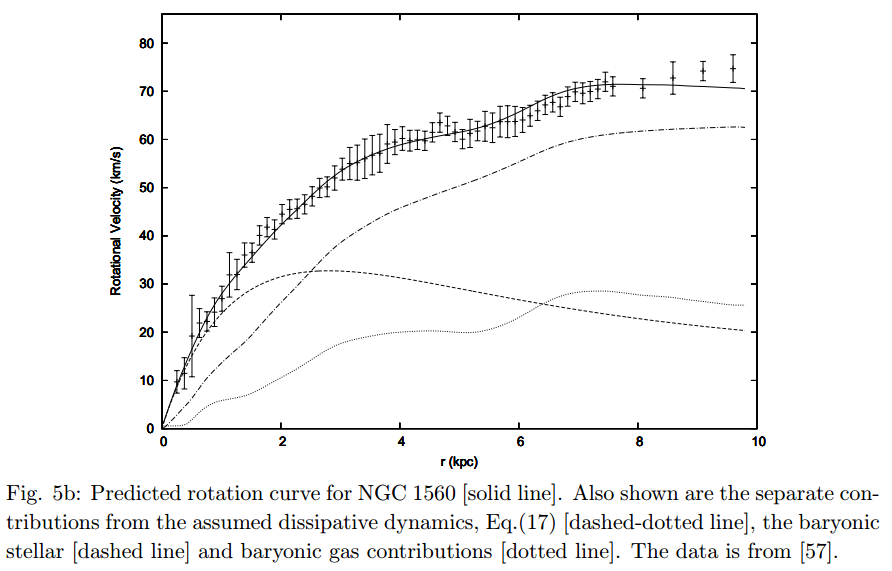
  • An arXiv preprint has shown that a one-parameter generic dissipative dark matter model with supernovae heat source can explain the 'wiggles' in rotation curve data. Assuming that DM cooling is balanced by this heating mechanism and the DM density is in a stable state, it is shown that the density of DM is related to the supernovae formation rate in the disk. If the SN rate is related to the gas density via a Kennicutt-Schmidt law, then the DM density is connected to the baryonic gas density in the disk: $$\rho(r,\theta)=\tilde\lambda \int d\tilde\phi \int d\tilde r \tilde r \frac{[\Sigma_{gas}(\tilde r)]^N}{4\pi[r^2+\tilde r^2-2 r \tilde r \sin\theta\cos\tilde\phi]},$$where $N\approx 2$, and $\tilde\lambda$ is an appropriately averaged quantity which depends on the cross section, supernovae dark photon energy spectrum etc.

    You can now go out and apply this equation to gas density measurements and predict the rotation curve up to the constant $\tilde\lambda$. This was done for the spiral galaxy NGC1560 (below):


    There are more examples in the paper, fitting to dwarf galaxies from the LITTLE THINGS survey released last month. Reasonably good fits are obtained, especially considering it is only a one-parameter model; the best fit values of $\tilde\lambda$ vary only within a factor of two.
  • The PICO-2L C3F8 Bubble Chamber in SNOLAB have reported the most sensitive direct detection constraints on WIMP-proton spin-dependent scattering to date. Below is a plot which compares various limits.


    The limits which appear to "beat" PICO-2L come along with some assumptions: IceCube, ANTARES, and SuperK are neutrino telescopes looking for annihilating dark matter in the sun; CMS/ATLAS search for mono-X signatures and assume an effective field theory (valid if the mediator mass is $\gg\sqrt{\hat{s}}$). In the conclusion they claim "These limits represent... the first time supersymmetric parameter space has been probed by direct detection in the SD-proton channel." Can't help but doubt this...
  • The Neutrino Telescopes conference (NeuTel XVI) is well under way and is keeping a blog here which contains summaries of talks and posters. I really like this method for gathering in one place succinctly and accessibly the important information; of course one can still access the full talks to find out more.

    Here is one interesting post from Francesco Iachello. He claims that quoted neutrinoless double beta decay bounds are too strong by a factor 2.5--6 due to the overestimate of a nuclear matrix element factor. This would mean that the inverted hierarchy region still allowed by Planck cannot be probed by $0\nu2\beta$ experiments in near future.
  • There is an interview with Jamie Bock of the BICEP2 experiment at Sean Carroll's blog. Here is an excerpt on the decision to release results when they did: The question really is, should we have waited until better data were available on galactic dust? Personally, I think we did the right thing. The field needed to be able to react to our data and test the results independently, as we did in our collaboration with Planck. This process hasn’t ended; it will continue with new data. Also, the searches for inflationary gravitational waves are influenced by these findings, and it is clear that all of the experiments in the field need to focus more resources on measuring the galaxy.
  • Twenty years ago on Tuesday was the discovery of the top quark at Tevatron. The papers of CDF and D0 were released together and can be read for free at PRL Milestones. Top at Twenty at Fermilab is celebrating this milestone from 9-10 April, in the traditional way of particle physicists: talks! Reviews of fundamental measurements of the top quark, measurements of top quark production and decay, theoretical talks on how the top quark fits into the Standard Model and its potential extensions, etc...
  • I don't know how significant this tweet from today is, but perhaps something to be aware of... [Edit: never mind, must have been minor (see second tweet)]

    • A paper published yesterday in Science has measured the D/H enrichment of atmospheric water on Mars. They found a D/H value enriched by a factor of about 7 relative to Earth’s ocean, which indicates that Mars has lost most of its water to space -- about six times the amount presently locked up in the Martian ice caps. This implies that Mars once had an ocean covering 20% of the planet's surface, up to one mile deep, and was wet for >1.5 billion years. Plenty of time for life! There's a 4 minute video about it from NASA Goddard, or an article at the guardian if you prefer.
    • Another paper in Science reports the observation of a gravitationally lensed supernova forming an Einstein cross. Because of the different travel times for light rays taking different paths around the lensing cluster, it is suspected that the supernova explosion would have appeared before (1964 and 1995) in another part of the sky, and will appear again elsewhere some time before 2020. There's an NY Times article here with a video.
    • Here is Rolf Heuer on the European Commission's decision to divert €2.7 billion (4%) of the EU’s science funding programme, Horizon 2020, to alternative investments.
    • Not sure what to think of the following tweet from Murdoch, but with The Australian's recent flip-flopping on Abbott who knows...
    • If you aren't already following Sabine Hossenfelder blogging at BackReaction, you should. Two more interesting pieces from her this week: 1) Are pop star scientists bad for science? 2) Can we prove the quantization of gravity with the Casimir effect? Probably not.
    • Very many articles knocking around this week about Homer Simpson predicting the Higgs boson mass, apparently relating to Simon Singh's new(ish) book on Mathematics and The Simpsons. Actually, you can now read that chapter for free here.


      If you actually calculate it you find it to be $\approx 775$ GeV. Not so miraculous. Change the $\pi$ to a $\frac12$ and he does a lot better, but since we know that the Higgs mass is just a conspiracy of gravity, QCD, and the weak force, maybe he should have guessed $$ \approx \pi\left(\frac{m_p}{2m_W}\right)^8\sqrt{\frac{hc}{G}}, $$ at tree level of course.

    Friday, 20 February 2015

    Friday wrap-up: dark matter direct detection in Australia, ICARUS vs MiniBooNE...

    This week I have been at the CoEPP Annual Workshop on Australia's exclamation point. Highlights have included new results on the CKM unitarity triangle (Pesantez/Kandinsky) and the art installation about viXra. But actually, perhaps the most exciting thing is the update on the southern hemisphere underground lab, which is my first point...

    • The possibility of a direct dark matter detection experiment in Australia is increasing! The Victorian government has pledged $1.75 million to Stage 1 of the Stawell Underground Physics Laboratory and is seeking matching funds from the Commonwealth. This comes after a three-day workshop near Stawell (a few hours from Melbourne) in October last year with INFN representatives to discuss the possibility of collaborative research. The response from the Stawell community has been welcoming.

      In Hobart we heard an update on geological backgrounds. In short: neutron flux okay, gamma flux okay, radon flux high but manageable with surface air / adsorption on activated carbon / shielding. All good news.

      A detector in the southern hemisphere has the capacity to settle the case for the DAMA/LIBRA annual modulation signal. If the DAMA/LIBRA signal is real and originates from Earth's traverse through the dark matter halo, then the signal should not change for a similar experiment in the southern hemisphere. If the signal is spurious, due to some local Gran Sasso background or an unaccounted seasonal effect, then the signal will disappear or swap phase. A diurnal modulation signal might even be observed if dark matter is captured within the Earth. Any result would be an interesting result, and a new generation twin experiment would be particularly interesting.

      Professors Elisabetta Barberio and Geoff Taylor appeared on 936 ABC Radio Hobart and talked about it.
    • Related is a Wall Street Journal article about direct detection at Gran Sasso, specifically the Darkside-50 experiment. It includes a two minute video. 
    • ICARUS has updated and revised their comparison to the MiniBooNE $\nu_\mu$-$\nu_e$ oscillation anomaly, still suggesting an "unexplained nature or an otherwise instrumental effect for the MiniBooNE low energy event excess." The paper is worth reading if only for the maligning undertones... ICARUS already presented their results in July 2013 which appeared to rule out MiniBooNE at >99% CL:


      MiniBooNE posted a critical reply which "explains and corrects the mistaken analysis published by the ICARUS collaboration." The confusion seems to be in the translation between the reconstructed energy $E^{QE}_\nu$ and $E_{True}$. Let me quote an excerpt from the new ICARUS paper to give you a feel for their thoughts on the issue:

      It appears that the reconstructed energy is affected by a huge non-Gaussian smearing compared with the true neutrino energy, as clearly stated in [the MiniBooNE reply] (see Figure 2), in contrast with the much better 11% resolution on $\nu_e$ event energy quoted in a previous paper. This difference between $E_{True}$ and $E^{QE}_\nu$, for which MiniBooNE gave a quite elliptical explanation, is the major cause of the problem in using the L/E (or E/L) to compare data with expectations...

      They make two further remarks. First they argue that the MiniBooNE reply implies that MiniBooNE's own results were represented in a misleading way in the original paper, by being directly compared to LSND data. Second they point out that the MiniBooNE quoted errors are inconsistent from paper to paper, and they even have a plot comparing the errors to make the point.

      Anyway, upon updating the comparison, the MiniBooNE anomaly appears excluded at 90% CL but no longer at 99% CL.
    • LHC restart is expected in the last week of March:
    • The LHC PR machine has really started to gear up. Checking the In the News section at Interactions.org I count 26 news articles in the last week. It's the usual sell: the big bang, Higgs, SUSY, dark matter, and baryogenesis.
    • Old news, but I just learned that since the end of September last year you can search for papers in inspire by just copy-pasting a reference from a paper and using: find rawref "..." . That will save us a bit of time.
    • Here is a discussion with George Efstathiou (Kavli Institute, Planck) on Planck and inflation, quantum gravity, younger first stars, dark matter, primordial gravitational waves...
    • Natalie Wolchover at Quanta magazine always produces well-written and well-balanced articles (even Luboš agrees), and has delivered another one, this time on string theory; the byline asks, "Researchers are demonstrating that, in certain contexts, string theory is the only consistent theory of quantum gravity. Might this make it true?"
    • On the topic of Frank Wilczek, he has launched a mysterious web site for "Wolfcub Vision Inc".
    • On the arXiv now are two papers on the science, mathematics, and computation behind the black hole and wormhole visualisations in "\emph{Interstellar}".
    • It appears that Lisa Randall will be releasing a book "Dark Matter and the Dinosaurs" at the end of October this year. If you're wondering about the connection, Randall has an arXiv paper which links comet impacts to periodic transits of the Oort cloud through the galactic disk, hypothesised to align with a dark matter disk (if some component of dark matter is dissipative). Actually, The Economist picked up this story yesterday, though there's no mention of Randall. 
    • In video media...
    • The Pale Blue Dot photograph taken by Voyager 1 is 25 years old. Read the famous reflections by Sagan here. Voyager 1 entered interstellar space in mid-2012; it's still sending back data, but by 2030 will be unable to power any instrument. Click here to see where it is now.
    • Lastly, images from space...
      • Mysterious plumes are erupting on Mars (gif here) and as Dawn edges closer, the nature of the white spots on Ceres are still unknown: "We expected to be surprised; we did not expect to be this puzzled"; it will be in orbit on March 6. Are we living at the beginning of a sci-fi novel?