Follow @syymmetries
Showing posts with label direct detection. Show all posts

Friday, 29 January 2016

Friday wrap-up: diphoton uncertainties, dark matter uncertainties...

Wherein I list some (mostly) recent happenings, ramble a bit, and provide links, in an order roughly determined by importance and relevance to particle physics. Views are my own. Content very definitely skewed by my own leanings and by papers getting coverage, and it may not even be correct. It is a blog after all...

  • There's quite a bit of discussion over at Résonaances (see also the comments) surrounding the Davis-Fairbairn-Heal-Tunney paper proposing an underestimated systematic in the background parameterisation used in the ATLAS diphoton analysis. This (and related) discussion looks to have aided (according to the acknowledgments) the preparation of another paper from Bradley Kavanagh, which seems to clarify the issue. In that paper it is written:

    Davis et al. introduce a different possible parametrisation for the background (which was also validated by a Monte Carlo study) and find that the significance of the excess is further reduced with respect to the k = 1, fixed-N case. However, the empty bins at high mγγ were not included in that analysis, leading to a background fit which overestimates the high mγγ event rate. Indeed, using the Davis et al. background parametrisation (with free normalisation) in this analysis gives a local significance of 3.8σ for a free-width resonance. This does not discount the possibility that exploring a wider range of possible background functions may impact the significance of the 750 GeV excess, but the correct constraints from the entire range of mγγ should be taken into account.
  • A few-interesting-papers appeared concerning baryonic effects on the local dark matter velocity distribution, of interest for interpreting direct detection experiments (see Matthew Buckley's blog for a write-up of one of them). Each of the papers takes a number of simulated Milky Way-like galaxies and looks at the dark matter distribution at Solar radius. Naturally, due to the small number of simulated galaxies, the papers reach slightly different conclusions. What is clear, though, is that there are significant uncertainties in both the local density and the local velocity distribution, which means that the usual direct detection limits you see drawn on e.g. σSI versus mχ space should be taken with a small grain of salt, since they assume the standard halo model. Also of note is that these effects alone cannot ameliorate tension with the DAMA/CoGeNT events. Further work in this area will be interesting to follow as additional (and more detailed) simulations become available.
  • Links without thinks
    • .Mic: "With One Hashtag, Female Astronomers Share Their Heartbreaking Stories of Harassment"
    • Nicolas Gisin via IQOQI: "Thought police – on arXiv?"
    • BackReaction: "Does the arXiv censor submissions?"
    • nature: "Hawking’s latest black-hole paper splits physicists"
    • Ars Technica: "The search for dark matter heats up"
  • A sad day for Comic Sans enthusiasts everywhere (nowhere?) -- apparently no more from Fabiola...

Saturday, 9 January 2016

Friday wrap-up: diphoton, self-interacting dark matter direct detection...

Back from the end of year break and getting stuck into new projects! Here is the first Friday wrap-up of 2016...

  • Fabiola Gianotti is now CERN's Director-General.
  • The 750 GeV diphoton monsoon which hit the arXiv on 16th December has not yet abated. There are 150-odd papers now up on the arXiv. See ReSonaances here and here, Tommaso Dorigo, and recent posts on the reference frame.

    I personally think that it is a good exercise for the hep-ph community to ask the question, if it is real, then what could it be? At least for the scientifically motivated reason that extra predictions are generally made which might be tested, and these predictions could in principle serve as a guide to tell experimentalists where to probe nature next (in the case that this turns out to be real). It is also sensible to collectively gather ideas which might help to fit the thing into a bigger picture. Unfortunately these good scientific motivations are confounded by citation-chasing, repetition, ill-motivated "Hail Mary" models, repetition, repetition, etc. We must also be aware of our (unscientific) cognitive bias toward fluctuations from the mean: given the statistical significance of the signal, is all this work sufficiently scientifically motivated? This is an interesting question, if rather academic... it is naive to think that scientists are (or even should be) motivated by purely scientific considerations.

    Anyway, the time should come for we as a community to sit back and take stock. The problem then is, among the noise, how to reduce the growing theory-space to a set of distinct generic predictions. I am considering pursuing this in the form of a wiki (or similar) as an experiment in large-scale collaboration; the idea would be to produce a summary document which represents a balanced cross-section of hep-ph ideas on this thing (with no cap on author count). The difficulties include the administrative one of keeping such a project economic and efficient, but also keeping a fair balance and controlling the (possibly inevitable) politics involved. If you have ideas or would like to get involved in such a project, please leave a comment or send me an email, so that I may gauge the interest in such a thing...

    There is not too much more to say except that there are myriad explanations for this possible signal, and I think it is sensible to be ready if it does turn out to be real. That being said, it would take a brave person to claim that the odds are in its favour...
  • Before Christmas we finished up on a fun project: "Plasma dark matter direct detection." The paper concerns what is a rather under-appreciated and somewhat generic point about self-interacting dark matter models and direct detection experiments. The logic goes like this:

    (1) If dark matter is self-interacting and capable of giving a direct detection signal, then some amount will be captured within the Earth. (2) The annually varying dark matter wind will interact with this captured dark matter in a highly non-trivial way. (3) This will result in a complex space- and time-varying dark matter near-Earth environment. (4) The dark matter detector moves through this environment throughout the day/year, and the rate it measures will be a time-average of the local rate along its path through space.

    In the well studied WIMP dark matter scenario, there is no spatial dependence of the dark matter distribution near the Earth, and so it doesn't matter where your detector is in space. Our scenario is quite different. Both the dark matter wind speed and the detector's daily path annually modulate due to the Earth's motion around the Sun. These modulations have different phases (155 days vs 115 days). So now you have two sources of annual modulation which, due to the complex dark matter environment, give an annually modulating rate which does not necessarily resemble a sinusoid. The following animations should help to visualise this picture:


    These are two simplified captured dark matter scenarios (fully absorbing/reflective) which we considered. The dark matter wind comes in from the left and its speed annually modulates. The direction of the Earth's rotation axis with respect to the wind also annually modulates, and therefore so do the detectors' daily paths: the black, green, orange, red bars represent the location of detectors in Gran Sasso, Kamioka, China Jin-Ping, and Stawell, respectively. Clearly, due to the complex environment, they will measure very different things! This is the qualitative picture; to make quantitative predictions is very difficult. This is why multiple experiments at multiple latitudes will be important for probing this scenario, especially experiments in the Southern Hemisphere (such as Stawell) which inhabit a unique location behind the Earth with respect to the wind.

    Lastly, the generic and distinctive prediction of these models is a possibly strong and non-trivial modulation as a function of time of sidereal day (diurnal modulation). A sidereal day is an "astronomical day" slightly shorter than a 24 hour day; there are approximately 366 sidereal days in a year. It is hard to imagine any background process which would modulate with period of one sidereal day. It therefore seems like a very sensible dark matter search to perform in addition to an annual modulation search.
  • Already in a few previous posts I mentioned the recent XMASS annual modulation search and its possible hint of a modulation signal with opposite sign to that of DAMA. Out of interest, last week I got around to scraping their central values from the data in the backup slides of their TAUP talk [pdf]. Below I present their measurement of rate as a function of time for energy bins summed from 0.5--2.0 keV57Co.


    The error bars are statistical only (though they dominate the systematic error) and have been estimated assuming equally spaced bins (which is not exactly correct); these errors are therefore only there to guide the eye and the actual ones would be if anything slightly larger. For interest the sinusoid of best fit, with a phase of 129 (or 311) days, is also plotted.

    Their result is clearly intriguing. It looks convincing to me, though one would need another year of data to tell for sure, and it will be interesting to see whether this effect continues in their fiducial volume (this analysis is full volume). What's going on here? It is consistent with a seasonal effect, but with amplitude opposite to that of DAMA. Though possible, if the modulation is due to an environmental effect then at least qualitatively this seems strange, since each of XMASS/DAMA are in the Northern Hemisphere (XMASS at Kamioka 36°N, DAMA at 43°N). The results of the annual modulation experiments sure are puzzling: there are four published now each seeing an effect at some level (though apart from DAMA are statistically weak)...

    Time might tell, but a speculative observation: if the XMASS effect is due to a non-trivial dark matter distribution, then the small change in latitude suggests that their signal will almost certainly be accompanied by large diurnal variation. So if XMASS see annual modulation in their fiducial volume, I would be very interested to see their search for a diurnal signal.
  • The XXII The Cracow Epiphany Conference on Run II LHC Physics (indico) is currently on.
  • In audio/video media:
    • In Particular: Things That Go Bump In The Light, on the diphoton excess. [21:47]
    • omega tau: String Theory. [2:43:07]
    • CBC radio: Similes and Science, on the Big Bang, string theory, black holes. [53:58]

Sunday, 20 December 2015

Friday wrap-up: diphoton excess, no diboson, no gluinos...

What a week! We have already seen some 40-odd papers submitted to hep-ph in the last few days on the "recent observed diphoton resonance" [1]. Well I certainly wouldn't go that far but ATLAS and CMS have each seen an excess of events in the diphoton spectrum at around 750 GeV, which is amazing since apparently they weren't even searching for it [2], and anyway beside the point because they also discovered a gluino [3]. Sloppy science writing aside, what do we know?...

  • The CMS and ATLAS Run II physics results presentations can be found here. Of course, all results presented are preliminary. The result that has hep-ph buzzing, though, is a little bump atop the falling diphoton invariant mass background (conference notes here and here). [See Jester, Motl, Strassler (here and here), PhysicsMatt, or Eilam Gross for some physicist perspectives. Else in popular media I thought the NY Times article was fairly balanced, but then I am a phenomenologist]. You can eyeball the bumps in question below (credit to Strassler for this image):


    But what about the numbers? The rumours were as accurate as one could reasonably ask: assuming a narrow width resonance, CMS observed a 2.6σ local (1.2σ global) excess at 760 GeV [increases to 3.0σ local (1.7σ global) at 750 GeV when combined with the 8 TeV data], and; ATLAS observed 3.6σ local (2.0σ global) at 750 GeV [have not yet combined with 8 TeV, but if they did it appears the significance would fall]. Allowing the width to float to larger values, the CMS result goes down to 2.0σ local, whereas ATLAS observes a best fit 45 GeV (6%) width at 3.9σ local (2.3σ with multivariate look-elsewhere). The relevant slides are below:


    It is a tantalizing excess. Sensibly, what one would like to know is the global significance of the fully combined (CMS+ATLAS 8+13 TeV) datasets. It is non-trivial to get an exact number (see here or here), but one can at least make a good bet that it's greater than about $\sim \sqrt{1.7^2+2.0^2}\approx 2.6\sigma$, perhaps in the vicinity of $\sim 3\sigma$. [I would imagine the demand for a joint analysis is high enough to be a priority for the collaborations (or they might try to avoid feeding the hep-ph sharks?), so maybe we will have that number by Moriond]. This being a (very rough!) ~1/300 chance then, and given the hundreds of plots CMS and ATLAS produce, it is very possible that this is just a statistical fluctuation. Nonetheless, this excess is being taken fairly seriously, and will be exercising our scrolling finger on hep-ph for the foreseeable future while we grapple with the sensible question: if it is real, then what could it be and what does it imply? The answer to this question may have implications for the experimental program of the LHC over the next few years (at least), and so phenomenologists are already relentlessly hard at work...

    So let's try to answer that question: what could it be? Well, there is no evidence for any extra activity in the excess events, so it appears consistent with a simple $gg\to X\to \gamma\gamma$ resonance. If taken as a resonance, the events translate to a cross-section $\sigma(pp\to X)\times Br(X\to \gamma\gamma)$ of $\sim 2$/fb ($\sim 6$/fb) in the narrow (wide) width scenario. Let us try to build a model with these properties. The simplest thing is to add a scalar singlet to the standard model. To couple it to gluons and photons let's borrow the Higgs' trick and couple it to some coloured/charged fermion(s) which then induce the couplings via a loop. Let's try Yukawa coupling it to a vector-like up-type quark first, write down the effective couplings, and calculate the Yukawa necessary; we find that it has to be huge ($\sim 5$ or so). And there's a potential problem, since the singlet will want to decay most of the time to the up-type quark. That's okay! We will just make it heavy enough (> 375 GeV) so that it's not allowed. Now we're done, and this solution is "already well-known" [4]. We can add more vector-like fermions to quell the large Yukawa(s) somewhat and/or dial the $gg$ and $\gamma\gamma$ couplings independently. If we take the large width seriously, we still have to add extra decay channels, and then dial up the production and/or branching to photons to compensate. The obvious options are a dark sector or some other standard model states, which we have to hide from previous searches. We could also try constraining ourselves inside some more predictive (restrictive) model.

    Of course there are several papers on just the above, the implication being that you need more than just the singlet scalar, which is obviously quite interesting. The immediate implications for the LHC are: look for anything at 750 GeV in $jj, Z\gamma, ZZ$ (in roughly descending order of promise) as soon as is possible.

    But this is just a minimal model. It could also be a scalar/pseudoscalar/bound state connected to compositeness/extended gauge group/extra dimensions/hidden valley/SUSY/dark matter/naturalness, and you can be sure there are already arXiv submissions on all of these. On that, it seems to me that arXiv isn't quite the ideal platform for all this. It would be nice instead to have all the various proposals in the same place, with the same formatting, in no-nonsense form, all grouped by some general properties. Then the interested phenomenologist/experimentalist could go and browse a list of, for example: (1) candidate; (2) production; (3) couplings; (4) decays; (5) associated activity; (6) additional particles; (7) additional predictions. Of course this will inevitably be done anyway by some authors in a review, but it seems like the same could be achieved much more efficiently with a community-run wiki or similar, as long as there were some moderators willing to dedicate their time to such a project... any thoughts on this from readers?

    In my book there's not much more to say except we need more data, to tell (1) if this is real, or (2) what it is. Looking forward to more excellent work from our experimental colleagues in the new year.

  • Now onto other matters from the presentation. First the diboson excess from Run I. Before the meeting a couple of useful papers appeared on the arXiv: a third-party CMS+ATLAS statistical combination, and; a thorough summary and literature survey. Now we know both CMS and ATLAS see nothing significant in Run II data (although they do not have sensitivity to conclusively probe the parameter space of interest):

  • Also in Run II data, the on-Z excess is not seen by CMS, but still persists at ATLAS...

  • As well, lots of gluino searches in different final states but nothing seen, and limits improve to roughly 1.2--1.8 TeV in the simplified models considered (but of course there are always compressed places to hide!).
  • CMS have not unblinded any of their Higgs analyses, but ATLAS reported results in γγ and ZZ: they were expecting 3.4σ observation and saw instead 1.4σ. Obviously the Higgs has packed up, moved to 750 GeV, and remembered its earlier proclivity for photons (this hypothesis will be robustly tested in upcoming LHC analyses).
  • Moving on to other news, LUX has released new limits on spin-independent dark matter nucleon scattering. See the press release and/or this blog post from Sally Shaw for a summary. They're almost observing solar neutrinos!

  • "NuPhys2015: Prospects in Neutrino Physics" was on this week (indico).
  • Links without thinks:
    • Strumia's insta-paper archive.
    • Quanta: "A Fight For the Soul of Science," on the recent meeting at the intersection of the philosophy of science and theoretical physics.
    • Quanta: "Landmark Algorithm Breaks 30-Year Impasse."
  • In audio/video media:

[1] arXiv: "The recent observed diphoton resonance around 750 GeV at the LHC..."
[2] Nature News: "... the 750 GeV boson is not one of the particles that LHC physicists have been searching for..."
[3] Tech Times: "Physicists Have Discovered Evidence Of A Gluino Particle, The Cousin Of The Higgs Boson."
[4] arXiv: "It is already well-known that a real singlet scalar ϕ with Yukawa couplings ϕXX to vector-like fermions X with mass mX>mϕ/2 can easily explain the observed signal, provided X carries both SM color and electric charge."


Saturday, 12 September 2015

Friday wrap-up: XMASS, multi-component dark matter...

Wherein I list some (mostly) recent happenings, ramble a bit, and provide links, in an order roughly determined by importance and relevance to particle physics. Views are my own. Content very definitely skewed by my own leanings and by papers getting coverage, and it may not even be correct. It is a blog after all...

  • The XIV International Conference on Topics in Astroparticle and Underground Physics (TAUP 2015) conference has been happening this week (hashtag here). The plenary talks are available but unfortunately a very many interesting parallel sessions are inaccessible...
  • One of those parallel sessions included a preliminary new result of the search for an annual modulation signal at XMASS. A summary and some plots can be found in this document [pdf]. They see "a weak modulation effect" which they say can be explained by a modest fluctuation background fluctuation, i.e., not significant results. Such are the difficulties in searching for annual modulation in only ~1.5yrs of data. No quote of the phase, but the fit for the modulation in their Figure 1 (below) has a negative amplitude, which might suggest that the best fit phase is ~6 months displaced from the standard halo model maximum in June... anyone have more information?


  • Robert Foot here in Melbourne maintains that it is still possible that dark matter could be the explanation for annual modulation signals seen by DAMA/LIBRA, CoGeNT, and recently by XENON100 (and now perhaps XMASS?). He posted to the arXiv last week outlining a scenario...

    The possible explanation is predicated on a dark matter halo made up of a pressure supported multi-component self-interacting plasma. Considering the mirror dark matter model for definiteness, the halo is mostly made up of dark electrons and dark He ions. There is a (massless) dark photon which mixes with the SM photon, imbuing the dark matter with dark charge and SM nanocharge. Far from the Earth the plasma is in thermal equilibrium; turns out this naively implies a ~100 times larger flux of dark electrons incident on the Earth than dark He. However, dark matter will be captured within the Earth, and by contradiction one can argue that dark electromagnetic fields must arise to equilibrate the (charge weighted) flux of dark electrons and dark He. The flux of the dark electrons on the Earth's surface, which can be possibly detected in direct detection experiments via single electron scattering, then depends on the details of these dark fields, which are assumed to arise from bulk movement of the charged dark matter on/near the surface of the captured dark matter sphere. Since the flux annually modulates due to the motion of the Earth relative to the halo, then so will these dark fields, and so will the electron flux incident on the Earth's surface. Needless to say, determining the flux is a very thorny dynamical problem... the preprint presents a "somewhat primitive" analysis to show in principal that such physics can give a large annual modulation fraction (which is a function of latitude). The "smoking gun" (and the make-or-break) for this scenario is a large diurnal (daily) modulation.

    This just goes to highlight the obvious fact that direct detection results are not as simple as comparing exclusion curves in spin-independent nucleon scattering cross section versus mass.
  • Further on the direct detection front, Lateral Mag have a story on the dark matter direct detection project getting underway here in Australia, in the Stawell Underground Physics Laboratory (SUPL). Funding for the lab has been obtained, and construction should start early next year!
  • On this blog:
    • I have updated my thoughts on the hierarchy/naturalness problem from a month ago. I wanted to distinguish between a hierarchy problem and a naturalness problem; it is my opinion that these terms are used too loosely in modern hep parlance (and perhaps people have different definitions anyway), and this causes confusion (especially from the point of view of an impressionable PhD student). So...

      At least to me, the following definitions make sense: a hierarchy problem is an unexplained hierarchy of scales within a model, and; a naturalness problem (for a mass parameter) arises when a scale receives very large and physically meaningful quantum corrections. The SM+gravity suffers a hierarchy problem by definition, but it is not clear to me that this implies a naturalness problem for the electroweak scale. That is what I blogged about a month ago. Actually, taken this way, minimal supersymmetry alone doesn't solve the hierarchy problem (i.e. it has a mu problem). Nevertheless (and if it arises at the TeV scale) supersymmetry ensures that the electroweak scale does not have a naturalness problem whatever the theory of gravity, and whatever scales are introduced in between (such as a GUT scale), which is in my opinion a very nice property and an admirable achievement for such models.
    • Playing with google charts recently I added a geomap and new/returning pageview charts using google analytics tracking, the google analytics superproxy, and a little javascript withquerying. They're a little messy right now but the information is there; the blog is getting >500 views a week now, so thanks for reading!
  • News from space...
    • A detailed image of the bright spot on Ceres...


    • ... and incredible new images of Pluto and Charon!


Friday, 1 May 2015

Friday wrap-up: DM self-interactions, on-Z excess, AMS...

Wherein I list some (mostly) recent happenings, ramble a bit, and provide links, in an order roughly determined by importance and relevance to particle physics. Views are my own. Content very definitely skewed by my own leanings and by papers getting coverage, and it may not even be correct. It is a blog after all...

  • This arXiv preprint answers my hanging question from a couple of weeks ago as to how the recent Abell 3827 (four-)galaxy cluster measurement is $10^4$ times more sensitive to dark matter self-interactions than the larger scale Bullet Cluster type measurement that hit the news in late March. The answer according to the authors: it isn't! The system is composed of four galaxies, each with a dark matter subhalo, infalling into a larger dark matter halo. The subhaloes are observed to have lagged behind after a long infall period, with the possible interpretation that the dark matter is experiencing some DM-DM drag force that the stars are not. The claim in this new preprint is that the Massey et al paper made the assumption that the stars and the associated DM subhalo develop completely independently. But clearly they are gravitationally bound! And this matters. When taken into account, it is clear that a much stronger dark matter self-interaction is necessary to explain the offsets of the subhaloes from the stars. They find a strength $\sigma/m_{DM}\sim 3 \text{ cm}^2\text{g}^{-1}$, in tension with the limit from the larger clusters (also from Massey et al...).
  • On the ATLAS on-Z excess, I count already six articles dedicated to discussing/explaining it. In particular, this one points out that an explanation in terms of the simplified General Gauge Mediation model taken as a benchmark in the ATLAS paper is inconsistent with other measurements. As shown below, the white band preferred by the on-Z excess is disfavoured by a collection of other measurements.


    There are at least a-few-papers which claim that a decay chain more like $\tilde g \to q\bar{q}\tilde \chi_2^0 \to q\bar{q} Z \chi_1^0$ with a somewhat compressed spectra can go some way to explaining the excess while remaining consistent with other observations.
  • On the AMS antiproton-proton "excess" there have been a few more preprints showing up on the arXiv. I took a quick look at this one, which does the sensible thing: notes that propagation models can fit the data fairly well, and that there is no unambiguous excess (though there are always some that see things another way...), nevertheless we can use these models along with the observations to bound the dark matter annihilation contribution at high energies -- which is the interesting physics after all!


    Above are the limits they derive on the annihilation cross-section into $b\bar{b}$ obtained assuming two different propagation models. What's interesting is that they compete with the Fermi dwarf spheroidal bounds for $m_{DM}\lesssim 100$ GeV, which is the region of interest for the galactic centre excess.
  • The Stawell Underground Physics Laboratory project aiming at setting up the southern hemisphere's first dark matter direct detection experiment looks like it's really coming along (It even has a Wiki page now)! There was a stakeholder event in Stawell on Tuesday and some buzz from the CAASTRO group on twitter...

  • Ellis, Gaillard, and Nanopoulos have uploaded "An Updated Historical Profile of the Higgs Boson" to the arXiv.
  • Another nice-couple of articles at Quanta Magazine on quantum phenomena.

Friday, 6 March 2015

Friday wrap-up: Higgs LFV decays, Higgs width, dissipative DM and rotation curves...

Wherein I list some (mostly) recent happenings, ramble a bit, and provide links, in an order roughly determined by importance and relevance to particle physics. Views are my own. Content very definitely skewed by my own leanings and by papers getting coverage, and it may not even be correct. It is a blog after all...

  • CMS has submitted their paper on the search for LFV Higgs decays. This analysis supersedes the PAS from July (which has 20 citations). They see an excess of 2.4σ, which I wouldn't make much of, but it is worth keeping track of these "hints" because they motivate papers you see popping up on hep-ph. The following is a quick summary...

    They search in the $\mu\tau$ channel, which is experimentally the best channel in which you might hope to see something after taking into account bounds from LFV transitions. The best fit branching ratio for the excess corresponds to $Br(H\to \mu\tau)=0.84\%$, an order of magnitude below bounds from $\tau\to\mu\gamma$. The dominant backgrounds for the search are $Z\to\tau\tau$, $W+jets$, QCD multijets, and $t\bar{t}$. The latter three are certainlysome of the nastiest backgrounds around at the LHC. $W+jets$ in particular is responsible for a number of historical anomalies (see Tomasso's blog or his talk). Happily they can be estimated with the help of data in background-enriched regions, which is nice, but shape uncertainties must then be carefully considered as systematics. Anyway, let us move on to the results...


    The left and right columns correspond to the leptonic and hadronic $\tau$ decay channels respectively, and each row corresponds to an increasing number of jets (the last row is enhanced with VBF events). The variable they plot against is the collinear mass $M_{col}$, an estimator for the Higgs mass (in the signal events) constructed by assuming the neutrino (coming from the $\tau$ decay) momentum is equal to the projection of the missing momentum vector onto the direction of the $\tau$ decay products. The distributions driving the excess are $\mu\tau_e\;0$-jet, $\mu\tau_e\;1$-jet, and $\mu\tau_h\;2$-jet. That can be seen by eye above and in the branching fits themselves:


    One would assume (or hope?) that the ATLAS analysis is underway, and certainly it will be interesting to find out what they see.
  • ATLAS has bounded the Higgs width at < 22.7 MeV at 95% CL (SM is 4.1 MeV) using the off-shell $gg\to VV$ Higgs boson signal, with assumptions (see below)! This supersedes their Conf Note from July and adds the WW channel to the analysis. The idea of doing this measurement (as far as I know) is based on the paper from Caola/Melnikov (1307). CMS managed to do the analysis and present it as a prepublication within 6 months of that paper (a phenomenal effort), rushed out for Moriond [pdf], and later published (in September) a bound of < 22 MeV at 95% CL [it should be noted that in the present ATLAS analysis the CLs method has been used which weakens their upper bound in the presence of the observed downward fluctuation of the low-statistics background; CMS used the regular $-2\ln L<4$ method and if ATLAS had done the same, judging by their Figure 12, their bound would rather be < 16.4 MeV]. The CMS result was presented as having "mild model-dependence," but not long after the bound was shown to be invalid for general new physics scenarios without some specific assumptions (see e.g. Englert/Spannowsky 1405). ATLAS appear to have specified clearly the assumptions going into their analysis...

    The ratio of the off-shell to on-shell g-g fusion signal strength is $$\frac{\mu_{\text{off-shell}}(\hat{s})}{\mu_{\text{on-shell}}}=\frac{\kappa^2_{g,\text{off-shell}}(\hat{s})\kappa^2_{V,\text{off-shell}}(\hat{s})}{\kappa^2_{g,\text{on-shell}}\kappa^2_{V,\text{on-shell}}}\frac{\Gamma_H}{\Gamma_H^{SM}},$$where the $\kappa$ are coupling scale factors of the Higgs to $gg$ and $VV$. The approximation CMS made was that the ratio of $\kappa$'s was equal to unity. ATLAS sets their limit under the assumption $$\kappa_{g,\text{on-shell}}^2\kappa_{V,\text{on-shell}}^2\le \kappa_{g,\text{off-shell}}^2\kappa_{V,\text{off-shell}}^2 .$$They also assume that none of any new physics which might alter the Higgs width changes substantially the background (of particular interest in this case since the off-shell signal and continuum background destructively interfere). The higher-order QCD corrections for the continuum background are not available, so in presenting their results they allow this K-factor to vary by a factor of 2 around that calculated for the SM Higgs.

    I find this measurement interesting as an independent way to probe the Higgs width. In principle it is possible to increase the Higgs width to > 22 MeV and have it consistent with all measurements, but it involves scaling up SM couplings while adding a new decay mode to keep the production×decay rate fixed. The global Higgs fit means that the upper bound on the Higgs branching to unobserved (not necessarily invisible) decays is < 21% for an otherwise SM Higgs
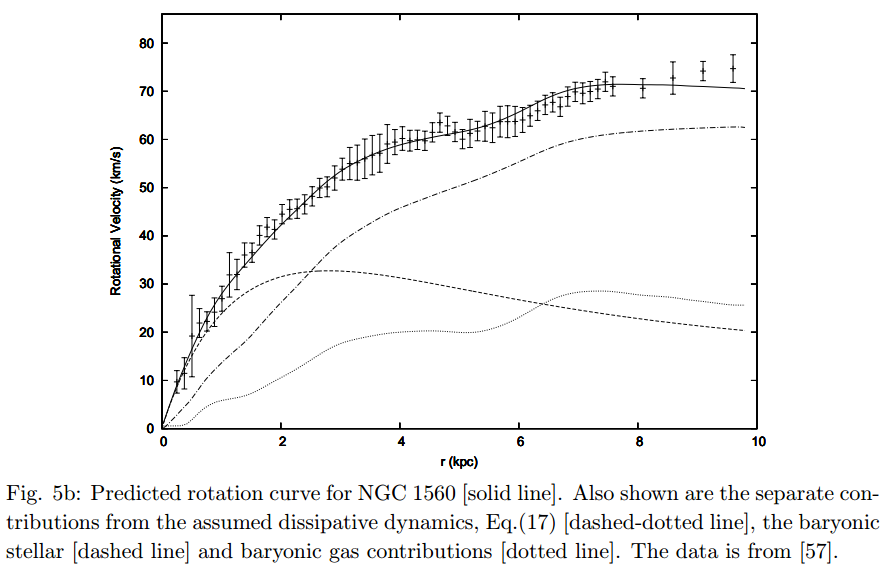
  • An arXiv preprint has shown that a one-parameter generic dissipative dark matter model with supernovae heat source can explain the 'wiggles' in rotation curve data. Assuming that DM cooling is balanced by this heating mechanism and the DM density is in a stable state, it is shown that the density of DM is related to the supernovae formation rate in the disk. If the SN rate is related to the gas density via a Kennicutt-Schmidt law, then the DM density is connected to the baryonic gas density in the disk: $$\rho(r,\theta)=\tilde\lambda \int d\tilde\phi \int d\tilde r \tilde r \frac{[\Sigma_{gas}(\tilde r)]^N}{4\pi[r^2+\tilde r^2-2 r \tilde r \sin\theta\cos\tilde\phi]},$$where $N\approx 2$, and $\tilde\lambda$ is an appropriately averaged quantity which depends on the cross section, supernovae dark photon energy spectrum etc.

    You can now go out and apply this equation to gas density measurements and predict the rotation curve up to the constant $\tilde\lambda$. This was done for the spiral galaxy NGC1560 (below):


    There are more examples in the paper, fitting to dwarf galaxies from the LITTLE THINGS survey released last month. Reasonably good fits are obtained, especially considering it is only a one-parameter model; the best fit values of $\tilde\lambda$ vary only within a factor of two.
  • The PICO-2L C3F8 Bubble Chamber in SNOLAB have reported the most sensitive direct detection constraints on WIMP-proton spin-dependent scattering to date. Below is a plot which compares various limits.


    The limits which appear to "beat" PICO-2L come along with some assumptions: IceCube, ANTARES, and SuperK are neutrino telescopes looking for annihilating dark matter in the sun; CMS/ATLAS search for mono-X signatures and assume an effective field theory (valid if the mediator mass is $\gg\sqrt{\hat{s}}$). In the conclusion they claim "These limits represent... the first time supersymmetric parameter space has been probed by direct detection in the SD-proton channel." Can't help but doubt this...
  • The Neutrino Telescopes conference (NeuTel XVI) is well under way and is keeping a blog here which contains summaries of talks and posters. I really like this method for gathering in one place succinctly and accessibly the important information; of course one can still access the full talks to find out more.

    Here is one interesting post from Francesco Iachello. He claims that quoted neutrinoless double beta decay bounds are too strong by a factor 2.5--6 due to the overestimate of a nuclear matrix element factor. This would mean that the inverted hierarchy region still allowed by Planck cannot be probed by $0\nu2\beta$ experiments in near future.
  • There is an interview with Jamie Bock of the BICEP2 experiment at Sean Carroll's blog. Here is an excerpt on the decision to release results when they did: The question really is, should we have waited until better data were available on galactic dust? Personally, I think we did the right thing. The field needed to be able to react to our data and test the results independently, as we did in our collaboration with Planck. This process hasn’t ended; it will continue with new data. Also, the searches for inflationary gravitational waves are influenced by these findings, and it is clear that all of the experiments in the field need to focus more resources on measuring the galaxy.
  • Twenty years ago on Tuesday was the discovery of the top quark at Tevatron. The papers of CDF and D0 were released together and can be read for free at PRL Milestones. Top at Twenty at Fermilab is celebrating this milestone from 9-10 April, in the traditional way of particle physicists: talks! Reviews of fundamental measurements of the top quark, measurements of top quark production and decay, theoretical talks on how the top quark fits into the Standard Model and its potential extensions, etc...
  • I don't know how significant this tweet from today is, but perhaps something to be aware of... [Edit: never mind, must have been minor (see second tweet)]

    • A paper published yesterday in Science has measured the D/H enrichment of atmospheric water on Mars. They found a D/H value enriched by a factor of about 7 relative to Earth’s ocean, which indicates that Mars has lost most of its water to space -- about six times the amount presently locked up in the Martian ice caps. This implies that Mars once had an ocean covering 20% of the planet's surface, up to one mile deep, and was wet for >1.5 billion years. Plenty of time for life! There's a 4 minute video about it from NASA Goddard, or an article at the guardian if you prefer.
    • Another paper in Science reports the observation of a gravitationally lensed supernova forming an Einstein cross. Because of the different travel times for light rays taking different paths around the lensing cluster, it is suspected that the supernova explosion would have appeared before (1964 and 1995) in another part of the sky, and will appear again elsewhere some time before 2020. There's an NY Times article here with a video.
    • Here is Rolf Heuer on the European Commission's decision to divert €2.7 billion (4%) of the EU’s science funding programme, Horizon 2020, to alternative investments.
    • Not sure what to think of the following tweet from Murdoch, but with The Australian's recent flip-flopping on Abbott who knows...
    • If you aren't already following Sabine Hossenfelder blogging at BackReaction, you should. Two more interesting pieces from her this week: 1) Are pop star scientists bad for science? 2) Can we prove the quantization of gravity with the Casimir effect? Probably not.
    • Very many articles knocking around this week about Homer Simpson predicting the Higgs boson mass, apparently relating to Simon Singh's new(ish) book on Mathematics and The Simpsons. Actually, you can now read that chapter for free here.


      If you actually calculate it you find it to be $\approx 775$ GeV. Not so miraculous. Change the $\pi$ to a $\frac12$ and he does a lot better, but since we know that the Higgs mass is just a conspiracy of gravity, QCD, and the weak force, maybe he should have guessed $$ \approx \pi\left(\frac{m_p}{2m_W}\right)^8\sqrt{\frac{hc}{G}}, $$ at tree level of course.

    Friday, 20 February 2015

    Friday wrap-up: dark matter direct detection in Australia, ICARUS vs MiniBooNE...

    This week I have been at the CoEPP Annual Workshop on Australia's exclamation point. Highlights have included new results on the CKM unitarity triangle (Pesantez/Kandinsky) and the art installation about viXra. But actually, perhaps the most exciting thing is the update on the southern hemisphere underground lab, which is my first point...

    • The possibility of a direct dark matter detection experiment in Australia is increasing! The Victorian government has pledged $1.75 million to Stage 1 of the Stawell Underground Physics Laboratory and is seeking matching funds from the Commonwealth. This comes after a three-day workshop near Stawell (a few hours from Melbourne) in October last year with INFN representatives to discuss the possibility of collaborative research. The response from the Stawell community has been welcoming.

      In Hobart we heard an update on geological backgrounds. In short: neutron flux okay, gamma flux okay, radon flux high but manageable with surface air / adsorption on activated carbon / shielding. All good news.

      A detector in the southern hemisphere has the capacity to settle the case for the DAMA/LIBRA annual modulation signal. If the DAMA/LIBRA signal is real and originates from Earth's traverse through the dark matter halo, then the signal should not change for a similar experiment in the southern hemisphere. If the signal is spurious, due to some local Gran Sasso background or an unaccounted seasonal effect, then the signal will disappear or swap phase. A diurnal modulation signal might even be observed if dark matter is captured within the Earth. Any result would be an interesting result, and a new generation twin experiment would be particularly interesting.

      Professors Elisabetta Barberio and Geoff Taylor appeared on 936 ABC Radio Hobart and talked about it.
    • Related is a Wall Street Journal article about direct detection at Gran Sasso, specifically the Darkside-50 experiment. It includes a two minute video. 
    • ICARUS has updated and revised their comparison to the MiniBooNE $\nu_\mu$-$\nu_e$ oscillation anomaly, still suggesting an "unexplained nature or an otherwise instrumental effect for the MiniBooNE low energy event excess." The paper is worth reading if only for the maligning undertones... ICARUS already presented their results in July 2013 which appeared to rule out MiniBooNE at >99% CL:


      MiniBooNE posted a critical reply which "explains and corrects the mistaken analysis published by the ICARUS collaboration." The confusion seems to be in the translation between the reconstructed energy $E^{QE}_\nu$ and $E_{True}$. Let me quote an excerpt from the new ICARUS paper to give you a feel for their thoughts on the issue:

      It appears that the reconstructed energy is affected by a huge non-Gaussian smearing compared with the true neutrino energy, as clearly stated in [the MiniBooNE reply] (see Figure 2), in contrast with the much better 11% resolution on $\nu_e$ event energy quoted in a previous paper. This difference between $E_{True}$ and $E^{QE}_\nu$, for which MiniBooNE gave a quite elliptical explanation, is the major cause of the problem in using the L/E (or E/L) to compare data with expectations...

      They make two further remarks. First they argue that the MiniBooNE reply implies that MiniBooNE's own results were represented in a misleading way in the original paper, by being directly compared to LSND data. Second they point out that the MiniBooNE quoted errors are inconsistent from paper to paper, and they even have a plot comparing the errors to make the point.

      Anyway, upon updating the comparison, the MiniBooNE anomaly appears excluded at 90% CL but no longer at 99% CL.
    • LHC restart is expected in the last week of March:
    • The LHC PR machine has really started to gear up. Checking the In the News section at Interactions.org I count 26 news articles in the last week. It's the usual sell: the big bang, Higgs, SUSY, dark matter, and baryogenesis.
    • Old news, but I just learned that since the end of September last year you can search for papers in inspire by just copy-pasting a reference from a paper and using: find rawref "..." . That will save us a bit of time.
    • Here is a discussion with George Efstathiou (Kavli Institute, Planck) on Planck and inflation, quantum gravity, younger first stars, dark matter, primordial gravitational waves...
    • Natalie Wolchover at Quanta magazine always produces well-written and well-balanced articles (even Luboš agrees), and has delivered another one, this time on string theory; the byline asks, "Researchers are demonstrating that, in certain contexts, string theory is the only consistent theory of quantum gravity. Might this make it true?"
    • On the topic of Frank Wilczek, he has launched a mysterious web site for "Wolfcub Vision Inc".
    • On the arXiv now are two papers on the science, mathematics, and computation behind the black hole and wormhole visualisations in "\emph{Interstellar}".
    • It appears that Lisa Randall will be releasing a book "Dark Matter and the Dinosaurs" at the end of October this year. If you're wondering about the connection, Randall has an arXiv paper which links comet impacts to periodic transits of the Oort cloud through the galactic disk, hypothesised to align with a dark matter disk (if some component of dark matter is dissipative). Actually, The Economist picked up this story yesterday, though there's no mention of Randall. 
    • In video media...
    • The Pale Blue Dot photograph taken by Voyager 1 is 25 years old. Read the famous reflections by Sagan here. Voyager 1 entered interstellar space in mid-2012; it's still sending back data, but by 2030 will be unable to power any instrument. Click here to see where it is now.
    • Lastly, images from space...
      • Mysterious plumes are erupting on Mars (gif here) and as Dawn edges closer, the nature of the white spots on Ceres are still unknown: "We expected to be surprised; we did not expect to be this puzzled"; it will be in orbit on March 6. Are we living at the beginning of a sci-fi novel?