Follow @syymmetries
Showing posts with label climate change. Show all posts

Friday, 6 March 2015

Friday wrap-up: Higgs LFV decays, Higgs width, dissipative DM and rotation curves...

Wherein I list some (mostly) recent happenings, ramble a bit, and provide links, in an order roughly determined by importance and relevance to particle physics. Views are my own. Content very definitely skewed by my own leanings and by papers getting coverage, and it may not even be correct. It is a blog after all...

  • CMS has submitted their paper on the search for LFV Higgs decays. This analysis supersedes the PAS from July (which has 20 citations). They see an excess of 2.4σ, which I wouldn't make much of, but it is worth keeping track of these "hints" because they motivate papers you see popping up on hep-ph. The following is a quick summary...

    They search in the $\mu\tau$ channel, which is experimentally the best channel in which you might hope to see something after taking into account bounds from LFV transitions. The best fit branching ratio for the excess corresponds to $Br(H\to \mu\tau)=0.84\%$, an order of magnitude below bounds from $\tau\to\mu\gamma$. The dominant backgrounds for the search are $Z\to\tau\tau$, $W+jets$, QCD multijets, and $t\bar{t}$. The latter three are certainlysome of the nastiest backgrounds around at the LHC. $W+jets$ in particular is responsible for a number of historical anomalies (see Tomasso's blog or his talk). Happily they can be estimated with the help of data in background-enriched regions, which is nice, but shape uncertainties must then be carefully considered as systematics. Anyway, let us move on to the results...


    The left and right columns correspond to the leptonic and hadronic $\tau$ decay channels respectively, and each row corresponds to an increasing number of jets (the last row is enhanced with VBF events). The variable they plot against is the collinear mass $M_{col}$, an estimator for the Higgs mass (in the signal events) constructed by assuming the neutrino (coming from the $\tau$ decay) momentum is equal to the projection of the missing momentum vector onto the direction of the $\tau$ decay products. The distributions driving the excess are $\mu\tau_e\;0$-jet, $\mu\tau_e\;1$-jet, and $\mu\tau_h\;2$-jet. That can be seen by eye above and in the branching fits themselves:


    One would assume (or hope?) that the ATLAS analysis is underway, and certainly it will be interesting to find out what they see.
  • ATLAS has bounded the Higgs width at < 22.7 MeV at 95% CL (SM is 4.1 MeV) using the off-shell $gg\to VV$ Higgs boson signal, with assumptions (see below)! This supersedes their Conf Note from July and adds the WW channel to the analysis. The idea of doing this measurement (as far as I know) is based on the paper from Caola/Melnikov (1307). CMS managed to do the analysis and present it as a prepublication within 6 months of that paper (a phenomenal effort), rushed out for Moriond [pdf], and later published (in September) a bound of < 22 MeV at 95% CL [it should be noted that in the present ATLAS analysis the CLs method has been used which weakens their upper bound in the presence of the observed downward fluctuation of the low-statistics background; CMS used the regular $-2\ln L<4$ method and if ATLAS had done the same, judging by their Figure 12, their bound would rather be < 16.4 MeV]. The CMS result was presented as having "mild model-dependence," but not long after the bound was shown to be invalid for general new physics scenarios without some specific assumptions (see e.g. Englert/Spannowsky 1405). ATLAS appear to have specified clearly the assumptions going into their analysis...

    The ratio of the off-shell to on-shell g-g fusion signal strength is $$\frac{\mu_{\text{off-shell}}(\hat{s})}{\mu_{\text{on-shell}}}=\frac{\kappa^2_{g,\text{off-shell}}(\hat{s})\kappa^2_{V,\text{off-shell}}(\hat{s})}{\kappa^2_{g,\text{on-shell}}\kappa^2_{V,\text{on-shell}}}\frac{\Gamma_H}{\Gamma_H^{SM}},$$where the $\kappa$ are coupling scale factors of the Higgs to $gg$ and $VV$. The approximation CMS made was that the ratio of $\kappa$'s was equal to unity. ATLAS sets their limit under the assumption $$\kappa_{g,\text{on-shell}}^2\kappa_{V,\text{on-shell}}^2\le \kappa_{g,\text{off-shell}}^2\kappa_{V,\text{off-shell}}^2 .$$They also assume that none of any new physics which might alter the Higgs width changes substantially the background (of particular interest in this case since the off-shell signal and continuum background destructively interfere). The higher-order QCD corrections for the continuum background are not available, so in presenting their results they allow this K-factor to vary by a factor of 2 around that calculated for the SM Higgs.

    I find this measurement interesting as an independent way to probe the Higgs width. In principle it is possible to increase the Higgs width to > 22 MeV and have it consistent with all measurements, but it involves scaling up SM couplings while adding a new decay mode to keep the production×decay rate fixed. The global Higgs fit means that the upper bound on the Higgs branching to unobserved (not necessarily invisible) decays is < 21% for an otherwise SM Higgs
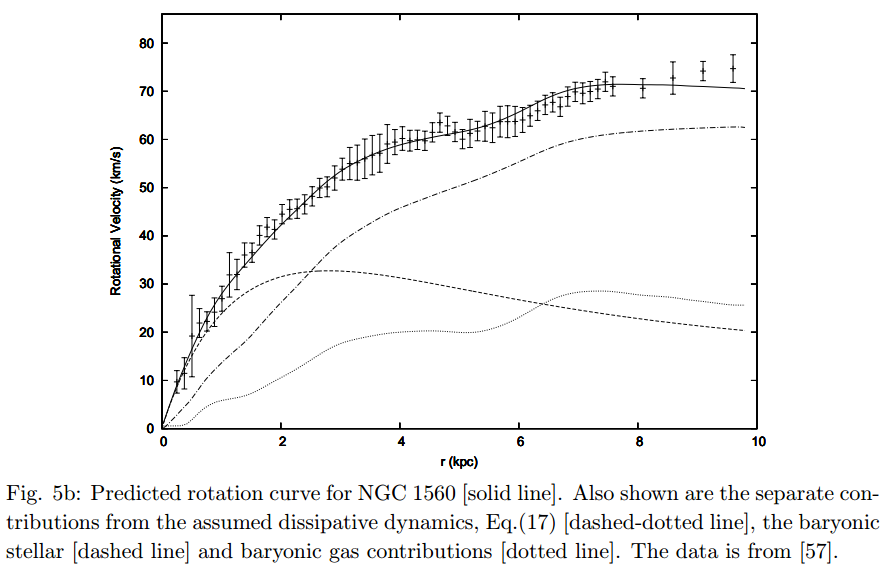
  • An arXiv preprint has shown that a one-parameter generic dissipative dark matter model with supernovae heat source can explain the 'wiggles' in rotation curve data. Assuming that DM cooling is balanced by this heating mechanism and the DM density is in a stable state, it is shown that the density of DM is related to the supernovae formation rate in the disk. If the SN rate is related to the gas density via a Kennicutt-Schmidt law, then the DM density is connected to the baryonic gas density in the disk: $$\rho(r,\theta)=\tilde\lambda \int d\tilde\phi \int d\tilde r \tilde r \frac{[\Sigma_{gas}(\tilde r)]^N}{4\pi[r^2+\tilde r^2-2 r \tilde r \sin\theta\cos\tilde\phi]},$$where $N\approx 2$, and $\tilde\lambda$ is an appropriately averaged quantity which depends on the cross section, supernovae dark photon energy spectrum etc.

    You can now go out and apply this equation to gas density measurements and predict the rotation curve up to the constant $\tilde\lambda$. This was done for the spiral galaxy NGC1560 (below):


    There are more examples in the paper, fitting to dwarf galaxies from the LITTLE THINGS survey released last month. Reasonably good fits are obtained, especially considering it is only a one-parameter model; the best fit values of $\tilde\lambda$ vary only within a factor of two.
  • The PICO-2L C3F8 Bubble Chamber in SNOLAB have reported the most sensitive direct detection constraints on WIMP-proton spin-dependent scattering to date. Below is a plot which compares various limits.


    The limits which appear to "beat" PICO-2L come along with some assumptions: IceCube, ANTARES, and SuperK are neutrino telescopes looking for annihilating dark matter in the sun; CMS/ATLAS search for mono-X signatures and assume an effective field theory (valid if the mediator mass is $\gg\sqrt{\hat{s}}$). In the conclusion they claim "These limits represent... the first time supersymmetric parameter space has been probed by direct detection in the SD-proton channel." Can't help but doubt this...
  • The Neutrino Telescopes conference (NeuTel XVI) is well under way and is keeping a blog here which contains summaries of talks and posters. I really like this method for gathering in one place succinctly and accessibly the important information; of course one can still access the full talks to find out more.

    Here is one interesting post from Francesco Iachello. He claims that quoted neutrinoless double beta decay bounds are too strong by a factor 2.5--6 due to the overestimate of a nuclear matrix element factor. This would mean that the inverted hierarchy region still allowed by Planck cannot be probed by $0\nu2\beta$ experiments in near future.
  • There is an interview with Jamie Bock of the BICEP2 experiment at Sean Carroll's blog. Here is an excerpt on the decision to release results when they did: The question really is, should we have waited until better data were available on galactic dust? Personally, I think we did the right thing. The field needed to be able to react to our data and test the results independently, as we did in our collaboration with Planck. This process hasn’t ended; it will continue with new data. Also, the searches for inflationary gravitational waves are influenced by these findings, and it is clear that all of the experiments in the field need to focus more resources on measuring the galaxy.
  • Twenty years ago on Tuesday was the discovery of the top quark at Tevatron. The papers of CDF and D0 were released together and can be read for free at PRL Milestones. Top at Twenty at Fermilab is celebrating this milestone from 9-10 April, in the traditional way of particle physicists: talks! Reviews of fundamental measurements of the top quark, measurements of top quark production and decay, theoretical talks on how the top quark fits into the Standard Model and its potential extensions, etc...
  • I don't know how significant this tweet from today is, but perhaps something to be aware of... [Edit: never mind, must have been minor (see second tweet)]

    • A paper published yesterday in Science has measured the D/H enrichment of atmospheric water on Mars. They found a D/H value enriched by a factor of about 7 relative to Earth’s ocean, which indicates that Mars has lost most of its water to space -- about six times the amount presently locked up in the Martian ice caps. This implies that Mars once had an ocean covering 20% of the planet's surface, up to one mile deep, and was wet for >1.5 billion years. Plenty of time for life! There's a 4 minute video about it from NASA Goddard, or an article at the guardian if you prefer.
    • Another paper in Science reports the observation of a gravitationally lensed supernova forming an Einstein cross. Because of the different travel times for light rays taking different paths around the lensing cluster, it is suspected that the supernova explosion would have appeared before (1964 and 1995) in another part of the sky, and will appear again elsewhere some time before 2020. There's an NY Times article here with a video.
    • Here is Rolf Heuer on the European Commission's decision to divert €2.7 billion (4%) of the EU’s science funding programme, Horizon 2020, to alternative investments.
    • Not sure what to think of the following tweet from Murdoch, but with The Australian's recent flip-flopping on Abbott who knows...
    • If you aren't already following Sabine Hossenfelder blogging at BackReaction, you should. Two more interesting pieces from her this week: 1) Are pop star scientists bad for science? 2) Can we prove the quantization of gravity with the Casimir effect? Probably not.
    • Very many articles knocking around this week about Homer Simpson predicting the Higgs boson mass, apparently relating to Simon Singh's new(ish) book on Mathematics and The Simpsons. Actually, you can now read that chapter for free here.


      If you actually calculate it you find it to be $\approx 775$ GeV. Not so miraculous. Change the $\pi$ to a $\frac12$ and he does a lot better, but since we know that the Higgs mass is just a conspiracy of gravity, QCD, and the weak force, maybe he should have guessed $$ \approx \pi\left(\frac{m_p}{2m_W}\right)^8\sqrt{\frac{hc}{G}}, $$ at tree level of course.

    Friday, 6 February 2015

    Friday wrap-up: Planck, Higgs to tau-tau, razors, top mass...

    Wherein I list some (mostly) recent happenings, ramble a bit, and provide links, in an order roughly determined by importance and relevance to particle physics.
    • Obvious big news item of the week is the release of the Joint Analysis of BICEP2/Keck Array and Planck Data (also on arXiv now), which derives an upper limit on the tensor-to-scalar ratio r<0.12 at 95% C.L., perfectly consistent with r=0. So, no evidence for primordial gravitational waves (yet). This is somewhat different from the original BICEP2 result r=0.20+0.07-0.05 with r=0 disfavoured at 7.0σ (lest we forget the YouTube reveal). That paper (from March last year) can be found on the arXiv. It is less than a year old with already almost 1000 citations! (And nature has a rundown on that). The important caveat can be found at the end of the abstract, emphasised after peer review and acceptance by Physical Review Letters: "Accounting for the contribution of foreground dust will shift this value downward by an amount which will be better constrained with upcoming data sets." Well, now we know that amount...

      Of course, this basic conclusion has been known for a while. Rumours began to circulate by May that the effect of polarised emission from the galactic dust foreground was problematic, that it was estimated (and misinterpreted) from preliminary figure in a slide shown at a conference. That month a couple of papers appeared on the arXiv arguing the point. Nevertheless the BICEP2 paper was accepted in June with the added caveat I mentioned above.
      In September Planck
      released their study of the polarised dust emission, showing that the effect of dust was likely of the same order of magnitude as the effect measured by BICEP2. There are some very good blog entries on this, see Sean Carroll, Katie Mack, In The Dark, Blank On The Map, Excursionset, Resonaances, etc. The plot below was enough to convince mostly everyone that the dust could account for all of the signal; it shows the "amount of B-mode polarisation" versus multipole moment, with blue the expected dust component and black the best fit theoretical prediction from gravitational waves claimed by BICEP2.

                           planck-bmode-spectrum

      The book was almost shut, but Planck reminded us that this was an extrapolation from a high frequency region to the lower frequency which BICEP2 observed. We were told to be patient physicists until the joint analysis was complete. The release was pushed back and back, but now here we are... primordial gravitational waves at r=0.2 are dead. So it goes.

      The upshot is that we do have gravitational lensing modes at 7.0σ! But wait, that number is familiar... Also, the following image was released which is just stunning and certainly worth a stare. The colour scale is for dust emission, and the texture is the orientation of the Galactic magnetic field. Outlined region is the BICEP2 patch.


      So what's next? Resonaances has a blog about that. Any non-zero measurement of r in the future will still be big news, and there are many experiments which will soon be sensitive to r~0.01. Certainly we could still see a primordial gravitational wave signal in the coming few years. Once again, we must sit and be patient physicists...
    • Today was the 2015 release of Planck full mission data products and scientific papers. The press release is here. The result they are spinning is that Planck measures the beginning of reionisation at 560 million years after the big bang, significantly later than the WMAP measurement of 420 million years. This is more consistent with observations from Hubble of the earliest galaxies (300-400 million years); now there's enough time for these structures alone to inject the energy needed to end the dark ages. I'm sure we will hear more about all their results in the coming week(s).

      They also released the full map in hi-res of the polarised emission from Milky Way dust, reminiscent of Van Gogh:

    • I missed this last week but ATLAS has released evidence for the Higgs-boson Yukawa coupling to tau leptons (actually there were quite a few releases, which is just the wrapping up of the remaining Run-I analyses). They measure a signal strength μ=1.43+0.43−0.37, and an excess of events over the expected background from other Standard Model processes with an observed (expected) significance of 4.5 (3.4) standard deviations. So they got somewhat lucky. Here's the plot:


      CoEPP has been involved in some of this analysis and I have seen a few talks on it in the past. I am always amazed, when I see the histograms before the BDT (and even after the BDT in each channel) that they are able to dig out this signal at all. Just look at this histogram of an important BDT input variable from one of the better channels, τlep+τhad:


      Doesn't look too bad, until you see that the signal histogram is presented 50x larger than it really is, just so you can see it. Obviously the experimentalists have plenty of tricks up their sleeves which are especially powerful when you know exactly what you're looking for. It's a remarkable analysis. And to be honest, if we required a local p-value of 5σ to "discover" the Higgs, when we didn't know its mass, then h→ττ with a significance of 4.5σ, when we know exactly where it should be... that's discovery in my book.
    • DZERO submitted the more detailed documentation on their top mass measurement originally published as a letter back in May. Their measurement is 174.98±0.76 GeV. They say in the abstract, "This constitutes the most precise single measurement of the top-quark mass," but that is no longer true. As far as I am aware that honour goes to CMS, with a measurement of 172.38±0.10(stat)±0.65(syst) GeV. (Evidently the LHC has a lot of top statistics!) Read more about that at Tommaso's blog post from four months ago. The Tevatron continues to pull the world average measurement up.

    • CMS released a new preprint: Search for supersymmetry using razor variables in events with b-tagged jets in pp collisions at √s = 8 TeV. The search constrains gluinos and stops.

      It is cool to see these razor variables in action! They're a very nice method for isolating new physics signals with pair-produced particles each decaying to visible+invisible. Other variables (which may be more familiar) are MT2, MCT and MCT⊥. (ATLAS used MT2 for their top squark search). The difficulty for such searches is how to deal with the fact that, in an event, we cannot know the momentum vectors of the invisible particles individually, but only reconstruct the total missing transverse momentum vector. So the general idea has been to construct kinematic variables which are an approximation of the mass scale of the underlying event, and which have a kinematic end-point (a maximum possible value) defined by the masses of the particles involved. The endpoint is exact at the parton truth-level but ends up being smeared by showering and detector effects. Above some e.g. MT2_{cut} there are expected to be very few SM events; usually MT2_{cut} ≈ m_W or m_t. Signal events will accumulate beyond MT2_{cut} since new physics is expected to have larger masses. Thus these variables are a very nice way to eliminate SM background in these kind of searches, applicable for R-parity conserving SUSY models with neutralino dark matter candidates, and leptoquarks.

      But they are not perfect. A problem with MCT for example is that the kinematic endpoint actually depends on the centre-of-mass of the pair-produced particle system. (This was eliminated with MCT⊥). Also, a lot of events end up piled at ~0 for both MCT and MT2. The razor approach avoids this problem by boosting from lab-frame to the particle-pair centre-of-mass frame with a "best guess" boost, and constructing a kinematic variable there. In general it performs at least as good as MCT⊥ and MT2 (see below).

      And they now have a successor: super-razor variables. Super-razor variables are designed to increase sensitivity in searches for specific decay topologies. To construct these variables one iteratively boosts from reference frame to reference frame with "best guesses", and at each stage you get some information about the masses (and mass splittings) involved. For example, in dislepton production where each slepton decays to a lepton and neutralino, there are three interesting frames to boost to. One advantage of this approach is that, along the way, you reconstruct some extra information such as decay angles which you can then use to help discriminate your signal. Click and look at the figure below to see its power...


      I am not aware of any ATLAS/CMS search which has employed the super-razor variables yet, but I look forward to seeing it in Run-II.
    • My supervisors and I have a letter paper out on the arXiv today. It is a short analysis of naturalness in the three-flavour Type I see-saw model, with the following take-home message: standard hierarchical thermal leptogenesis is unnatural, and there's no way out in the minimal model. I will write a short post about it next week some time.
    • According to a new arXiv preprint, there is no indirect dark matter signal from the Large Magellanic Cloud. The following figure tells the tale:


      The investigators expected to begin to probe the areas (see the brazil lines) of parameter space interesting for the galactic centre excess (four marked areas), but they aren't quite there yet. Matthew Buckley (one of the investigators) has some tweets about it (reading upwards, beginning Feb 5).

      [Edit 16/02: I read this paper in a little more detail last week. It is the first indirect dark matter search in the LMC, certainly worth doing as it is potentially the second brightest (after the galactic centre) annihilation source in our sky. However unlike dwarf galaxies there is a lot of baryonic matter to contend with; the authors use a data-driven method to model this. They end up seeing a broad excess which is consistent within systematic limitations of the background model (they stress this point, so it is not taken as further evidence for the Hooperon!). It should be noted that the above plot (their Fig. 22) is conservative in terms of the statistical analysis and choice of LMC centre, but it is optimistic in the halo profile. Assuming an NFW or Isothermal (cored) profile weakens these limits by an order of magnitude (see their Figs. 17 and 18). The analysis appears to be difficult yet worth attempting, unfortunately it cannot compete with the limit from dwarf galaxies, especially after Fermi Pass 8.]
    • Could the missing satellite problem be solved with just dark energy? This paper on the arXiv suggests the possibility, and new scientist ran a story. This is surprising, since I would have thought that this is already taken into account in simulations? What am I missing?
    • James D. "BJ" Bjorken was one of the two winners of the Wolf Prize in Physics this year. It is known as somewhat of a predictor for the Nobel. (Brout, Englert and Higgs were recipients in 2004). You can read about it at the official site, and also at Tomasso's blog. The former writes, "in retrospective, Bjorken's scaling not only led to the discovery of quarks, but also pointed the direction toward the mathematical framework governing all fundamental interactions." 
    • On Wednesday, Roman prosecutors closed the case on the disappearance Ettore Majorana. Majorana, who disappeared at sea in 1938 at 32 years of age, is now believed to have been alive and well, living in Valencia, Venezuela, between 1955-59.
    • I only just read that as of January 1, Physical Review journals and Physical Review Letters will allow article titles in the reference list. Huge.
    • Jester noted that the Symposium on Lepton Photon Interactions resembles a vomiting dragon. I'll let you to make up your own mind...

    • The Crayfis app for detecting ultra-high energy cosmic rays using a network of smartphones is already in beta testing. Read more about it from Kyle Cranmer in a blog post, or see the original paper from October last year.
    • On Monday, NASA released its fiscal year 2016 budget request
      • The exciting news: there is a request for $30mil to begin planning a mission to Europa! Bad Astronomy claims that the request has a decent shot, too, since it has a champion in Congress. Looks like this has been in the works for a while, JPL released somewhat of a promotional video for such a mission back in November. 
      • The sad news: the budget also suggests that there may be plans to cease Mars rover Opportunity operations. Meanwhile NASA JPL released a YouTube video celebrating 11 Years of Opportunity on Mars (the images of clouds at 0:46 really got me). Why stop now!
    • NASA has successfully launched the SMAP (Soil Moisture Active Passive) satellite observatory, which will gather three years of data on global soil moisture levels via a very cool-looking 6m rotating reflector. You can read about it at space.com or at NASA, and watch the launch here. It is the last of five Earth-observing space missions to be launched in the past year by NASA (including: Orbiting Carbon Observatory-2, Global Precipitation Measurement Core Observatory, ISS-RapidScat, and Cloud-Aerosol Transport mission). 
    • The US (Republican-led) Senate on 21 July passed an amendment to a bill 98-1 which stated: "It is the sense of the Senate that climate change is real and not a hoax." However they rejected, 50-49 with a requirement for 60, the stronger amendment: "It is the sense of Congress that 1) climate change is real, and 2) human activity significantly contributes to climate change." Senator Inhofe, who once claimed that global warming was "the greatest hoax ever perpetrated on the American people" claimed: "The hoax is that there are some people who are so arrogant to think that they are so powerful they can change climate. Man can't change climate." I'll leave that alone...
    • "Computational Linguistics Reveals How Wikipedia Articles Are Biased Against Women", as an article here or on the arXiv.
    • Last but certainly not least, here is some old news that I only recently discovered... an arXiv paper on predicting the length of winter in the world of Westeros. From the abstract: Thus, by speculating that the planet under scrutiny is orbiting a pair of stars, we utilize the power of numerical three-body dynamics to predict that, unfortunately, it is not possible to predict either the length, or the severity of any coming winter. We conclude that, alas, the Maesters were right -- one can only throw their hands in the air in frustration and, defeated by non-analytic solutions, mumble "Coming winter? May be long and nasty (~850 days, T<268K) or may be short and sweet (~600 days, T~273K). Who knows..."