Follow @syymmetries
Showing posts with label string theory. Show all posts

Friday, 8 May 2015

Friday wrap-up: Collisions, displaced Higgs decays...

Wherein I list some (mostly) recent happenings, ramble a bit, and provide links, in an order roughly determined by importance and relevance to particle physics. Views are my own. Content very definitely skewed by my own leanings and by papers getting coverage, and it may not even be correct. It is a blog after all...

  • The LHC has seen collisions at injection energy, 450 GeV per beam. There's a little more you can read at symmetry magazine; still plenty of calibration to be done. Here's one of the events in the ATLAS detector, a far cry from the messy environment we'll see at 13 TeV...


    As well, CMS has a visualisation of one of their events on YouTube.
  • Pheno 2015 happened this week in Pittsburgh. Definitely worth perusing the interesting talks on the indico page.
  • I uploaded an arXiv preprint on Monday, "Constraining portals with displaced Higgs decay searches at the LHC." One of the primary purposes of the LHC is to study the properties of the newly discovered Higgs boson in great detail. Even though we have now measured its mass to within ~0.2%, it is still possible that it is decaying to exotic particles 20% of the time! So it is clearly sensible to search for exotic Higgs decays. I concentrated on one possibility: the decay to a pair of long-lived particles which each subsequently decay around 1 metre from the beam pipe...

    Such long-lived particles are well-motivated; typically all you need is an approximate symmetry (which is by definition technically natural à la 't Hooft) in your model which if exact would result in a stable particle. This appears to be coming into vogue at the moment as we see natural SUSY being pushed into compressed and long-lived areas of parameter space; for example, if you violate R-parity just slightly then the would-be neutralino dark matter candidate can become long-lived. I became interested in this sort of phenomenology from a much simpler standard model (SM) extension: by a real singlet scalar field $S$. In that case you can write down a potential term $\zeta \phi^\dagger\phi S^2$ which mixes the Higgs boson and a new mass eigenstate $s$ after symmetry breaking. As $\zeta\to 0$ the $S$ field decouples from the SM and becomes stable, so for small $\zeta$ it is long-lived. It is possible that the $S$ also directly couples to some dark sector uncharged under the SM forces, so-called Higgs portal models. Anyway, the Higgs we know and love can decay to two $s$ particles which, in the simplest case, decay to SM particles somewhere in the middle of the detector. Else the $s$ could have some complex cascade decay into hidden sector states which subsequently decay in the middle of the detector (often called hidden valley models).

    You can do a similar thing with a massive dark photon, the so-called vector portal. In fact, the possibilities are many and varied, which presents two complementary challenges: how do collaborations present their results in the most model-independent way possible? and how do phenomenologists reinterpret the results in the context of their own models? The point of my paper was to explore these questions...

    So I had a go at reinterpreting two searches already performed by ATLAS, in a very simple way: by running Monte Carlo simulations, calculating decay probabilities, and folding in the provided particle reconstruction efficiencies as a function of the decay distance of the long-lived particles. As phenomenologists we are reliant upon these provided efficiencies, as there is no tool available to reliably calculate them ourselves. As we move on the journey which constitutes the bulk of the paper, we learn some valuable life lessons about what efficiency table information the collaborations could provide to make the life of phenomenologists wanting to reinterpret their searches (and there are a few of us out there!) much easier. Those life lessons are summarised in the conclusion.

    As well, at the end of the day I was able to make my own contribution to the portal model exclusion space, with the pretty pictures below...


  • There's an article at Nautilus on "The Admiral of the String Theory Wars" AKA Peter Woit. As might be intuited, the article describes the string theory wars around the time when Woit released his book, "Not Even Wrong." It touches on his arXiv trackback controversy and feud with Polchinski. (Also I learned that Motl once compared Woit to bin Laden...). Woit said a few words about the article on his blog. There is also some discussion there on the following...
  • You should be able to find Amanda Peet's hour long Perimeter Institute public lecture on string theory on YouTube within a day or so.

Friday, 20 February 2015

Friday wrap-up: dark matter direct detection in Australia, ICARUS vs MiniBooNE...

This week I have been at the CoEPP Annual Workshop on Australia's exclamation point. Highlights have included new results on the CKM unitarity triangle (Pesantez/Kandinsky) and the art installation about viXra. But actually, perhaps the most exciting thing is the update on the southern hemisphere underground lab, which is my first point...

  • The possibility of a direct dark matter detection experiment in Australia is increasing! The Victorian government has pledged $1.75 million to Stage 1 of the Stawell Underground Physics Laboratory and is seeking matching funds from the Commonwealth. This comes after a three-day workshop near Stawell (a few hours from Melbourne) in October last year with INFN representatives to discuss the possibility of collaborative research. The response from the Stawell community has been welcoming.

    In Hobart we heard an update on geological backgrounds. In short: neutron flux okay, gamma flux okay, radon flux high but manageable with surface air / adsorption on activated carbon / shielding. All good news.

    A detector in the southern hemisphere has the capacity to settle the case for the DAMA/LIBRA annual modulation signal. If the DAMA/LIBRA signal is real and originates from Earth's traverse through the dark matter halo, then the signal should not change for a similar experiment in the southern hemisphere. If the signal is spurious, due to some local Gran Sasso background or an unaccounted seasonal effect, then the signal will disappear or swap phase. A diurnal modulation signal might even be observed if dark matter is captured within the Earth. Any result would be an interesting result, and a new generation twin experiment would be particularly interesting.

    Professors Elisabetta Barberio and Geoff Taylor appeared on 936 ABC Radio Hobart and talked about it.
  • Related is a Wall Street Journal article about direct detection at Gran Sasso, specifically the Darkside-50 experiment. It includes a two minute video. 
  • ICARUS has updated and revised their comparison to the MiniBooNE $\nu_\mu$-$\nu_e$ oscillation anomaly, still suggesting an "unexplained nature or an otherwise instrumental effect for the MiniBooNE low energy event excess." The paper is worth reading if only for the maligning undertones... ICARUS already presented their results in July 2013 which appeared to rule out MiniBooNE at >99% CL:


    MiniBooNE posted a critical reply which "explains and corrects the mistaken analysis published by the ICARUS collaboration." The confusion seems to be in the translation between the reconstructed energy $E^{QE}_\nu$ and $E_{True}$. Let me quote an excerpt from the new ICARUS paper to give you a feel for their thoughts on the issue:

    It appears that the reconstructed energy is affected by a huge non-Gaussian smearing compared with the true neutrino energy, as clearly stated in [the MiniBooNE reply] (see Figure 2), in contrast with the much better 11% resolution on $\nu_e$ event energy quoted in a previous paper. This difference between $E_{True}$ and $E^{QE}_\nu$, for which MiniBooNE gave a quite elliptical explanation, is the major cause of the problem in using the L/E (or E/L) to compare data with expectations...

    They make two further remarks. First they argue that the MiniBooNE reply implies that MiniBooNE's own results were represented in a misleading way in the original paper, by being directly compared to LSND data. Second they point out that the MiniBooNE quoted errors are inconsistent from paper to paper, and they even have a plot comparing the errors to make the point.

    Anyway, upon updating the comparison, the MiniBooNE anomaly appears excluded at 90% CL but no longer at 99% CL.
  • LHC restart is expected in the last week of March:
  • The LHC PR machine has really started to gear up. Checking the In the News section at Interactions.org I count 26 news articles in the last week. It's the usual sell: the big bang, Higgs, SUSY, dark matter, and baryogenesis.
  • Old news, but I just learned that since the end of September last year you can search for papers in inspire by just copy-pasting a reference from a paper and using: find rawref "..." . That will save us a bit of time.
  • Here is a discussion with George Efstathiou (Kavli Institute, Planck) on Planck and inflation, quantum gravity, younger first stars, dark matter, primordial gravitational waves...
  • Natalie Wolchover at Quanta magazine always produces well-written and well-balanced articles (even Luboš agrees), and has delivered another one, this time on string theory; the byline asks, "Researchers are demonstrating that, in certain contexts, string theory is the only consistent theory of quantum gravity. Might this make it true?"
  • On the topic of Frank Wilczek, he has launched a mysterious web site for "Wolfcub Vision Inc".
  • On the arXiv now are two papers on the science, mathematics, and computation behind the black hole and wormhole visualisations in "\emph{Interstellar}".
  • It appears that Lisa Randall will be releasing a book "Dark Matter and the Dinosaurs" at the end of October this year. If you're wondering about the connection, Randall has an arXiv paper which links comet impacts to periodic transits of the Oort cloud through the galactic disk, hypothesised to align with a dark matter disk (if some component of dark matter is dissipative). Actually, The Economist picked up this story yesterday, though there's no mention of Randall. 
  • In video media...
  • The Pale Blue Dot photograph taken by Voyager 1 is 25 years old. Read the famous reflections by Sagan here. Voyager 1 entered interstellar space in mid-2012; it's still sending back data, but by 2030 will be unable to power any instrument. Click here to see where it is now.
  • Lastly, images from space...
    • Mysterious plumes are erupting on Mars (gif here) and as Dawn edges closer, the nature of the white spots on Ceres are still unknown: "We expected to be surprised; we did not expect to be this puzzled"; it will be in orbit on March 6. Are we living at the beginning of a sci-fi novel?

Friday, 30 January 2015

Friday wrap-up: Planck, HESS, exoplanets...


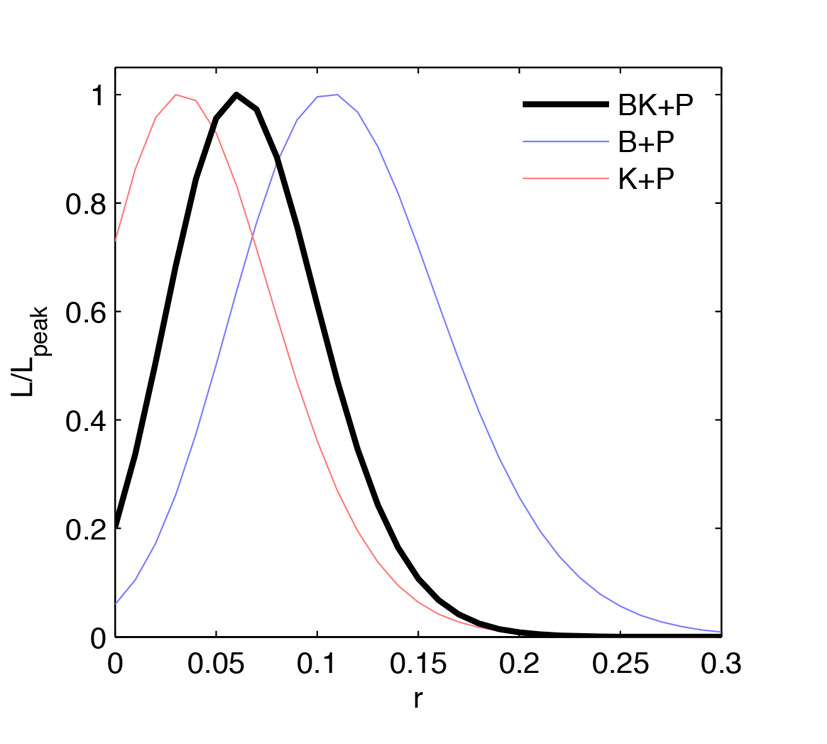
  • Today Planck has released a statement [edit: web site has been hidden, but luckily the internet keeps backups] [edit 2: paper is now available from here] about the combination analysis of BICEP2+KECK+Planck re: primordial gravitational waves. Be sure to click the "Expert" version for some plots. (English speakers try google translate). The bottom line is no significant non-zero measurement, with the tensor-to-scalar ratio r<0.13 at 95% C.L. It could just be dust.
    Embedded image permalink
    No doubt we will hear more about it in the coming week(s).
  • Richard Dawid's book "String Theory and the Scientific Method" and surrounding ideas of post-empirical science continues to cause waves within the blogosphere. The argument seems to be that String Theory is likely correct because: (a) there are few viable alternatives, (b) the more it is studied the more it appears to hold together coherently, and (c) it is the extrapolation of a previous programme of study (the Standard Model) which already succeeded. But without experiment to ground it in reality, is it science? We can go back to May for a couple of interesting book reviews from two opposing sides: Woit and Motl.
  • Worth a look also are pieces on Helen Quinn at Symmetry Magazine, and Yitang Zhang (of bounded prime gaps fame) in the New Yorker.
  • Lastly, AndromedaBot is a twitter account which tweets excerpts from Hubble's largest photo (of Andromeda) every half-hour.