Follow @syymmetries
Showing posts with label LHC. Show all posts

Sunday, 20 December 2015

Friday wrap-up: diphoton excess, no diboson, no gluinos...

What a week! We have already seen some 40-odd papers submitted to hep-ph in the last few days on the "recent observed diphoton resonance" [1]. Well I certainly wouldn't go that far but ATLAS and CMS have each seen an excess of events in the diphoton spectrum at around 750 GeV, which is amazing since apparently they weren't even searching for it [2], and anyway beside the point because they also discovered a gluino [3]. Sloppy science writing aside, what do we know?...

  • The CMS and ATLAS Run II physics results presentations can be found here. Of course, all results presented are preliminary. The result that has hep-ph buzzing, though, is a little bump atop the falling diphoton invariant mass background (conference notes here and here). [See Jester, Motl, Strassler (here and here), PhysicsMatt, or Eilam Gross for some physicist perspectives. Else in popular media I thought the NY Times article was fairly balanced, but then I am a phenomenologist]. You can eyeball the bumps in question below (credit to Strassler for this image):


    But what about the numbers? The rumours were as accurate as one could reasonably ask: assuming a narrow width resonance, CMS observed a 2.6σ local (1.2σ global) excess at 760 GeV [increases to 3.0σ local (1.7σ global) at 750 GeV when combined with the 8 TeV data], and; ATLAS observed 3.6σ local (2.0σ global) at 750 GeV [have not yet combined with 8 TeV, but if they did it appears the significance would fall]. Allowing the width to float to larger values, the CMS result goes down to 2.0σ local, whereas ATLAS observes a best fit 45 GeV (6%) width at 3.9σ local (2.3σ with multivariate look-elsewhere). The relevant slides are below:


    It is a tantalizing excess. Sensibly, what one would like to know is the global significance of the fully combined (CMS+ATLAS 8+13 TeV) datasets. It is non-trivial to get an exact number (see here or here), but one can at least make a good bet that it's greater than about $\sim \sqrt{1.7^2+2.0^2}\approx 2.6\sigma$, perhaps in the vicinity of $\sim 3\sigma$. [I would imagine the demand for a joint analysis is high enough to be a priority for the collaborations (or they might try to avoid feeding the hep-ph sharks?), so maybe we will have that number by Moriond]. This being a (very rough!) ~1/300 chance then, and given the hundreds of plots CMS and ATLAS produce, it is very possible that this is just a statistical fluctuation. Nonetheless, this excess is being taken fairly seriously, and will be exercising our scrolling finger on hep-ph for the foreseeable future while we grapple with the sensible question: if it is real, then what could it be and what does it imply? The answer to this question may have implications for the experimental program of the LHC over the next few years (at least), and so phenomenologists are already relentlessly hard at work...

    So let's try to answer that question: what could it be? Well, there is no evidence for any extra activity in the excess events, so it appears consistent with a simple $gg\to X\to \gamma\gamma$ resonance. If taken as a resonance, the events translate to a cross-section $\sigma(pp\to X)\times Br(X\to \gamma\gamma)$ of $\sim 2$/fb ($\sim 6$/fb) in the narrow (wide) width scenario. Let us try to build a model with these properties. The simplest thing is to add a scalar singlet to the standard model. To couple it to gluons and photons let's borrow the Higgs' trick and couple it to some coloured/charged fermion(s) which then induce the couplings via a loop. Let's try Yukawa coupling it to a vector-like up-type quark first, write down the effective couplings, and calculate the Yukawa necessary; we find that it has to be huge ($\sim 5$ or so). And there's a potential problem, since the singlet will want to decay most of the time to the up-type quark. That's okay! We will just make it heavy enough (> 375 GeV) so that it's not allowed. Now we're done, and this solution is "already well-known" [4]. We can add more vector-like fermions to quell the large Yukawa(s) somewhat and/or dial the $gg$ and $\gamma\gamma$ couplings independently. If we take the large width seriously, we still have to add extra decay channels, and then dial up the production and/or branching to photons to compensate. The obvious options are a dark sector or some other standard model states, which we have to hide from previous searches. We could also try constraining ourselves inside some more predictive (restrictive) model.

    Of course there are several papers on just the above, the implication being that you need more than just the singlet scalar, which is obviously quite interesting. The immediate implications for the LHC are: look for anything at 750 GeV in $jj, Z\gamma, ZZ$ (in roughly descending order of promise) as soon as is possible.

    But this is just a minimal model. It could also be a scalar/pseudoscalar/bound state connected to compositeness/extended gauge group/extra dimensions/hidden valley/SUSY/dark matter/naturalness, and you can be sure there are already arXiv submissions on all of these. On that, it seems to me that arXiv isn't quite the ideal platform for all this. It would be nice instead to have all the various proposals in the same place, with the same formatting, in no-nonsense form, all grouped by some general properties. Then the interested phenomenologist/experimentalist could go and browse a list of, for example: (1) candidate; (2) production; (3) couplings; (4) decays; (5) associated activity; (6) additional particles; (7) additional predictions. Of course this will inevitably be done anyway by some authors in a review, but it seems like the same could be achieved much more efficiently with a community-run wiki or similar, as long as there were some moderators willing to dedicate their time to such a project... any thoughts on this from readers?

    In my book there's not much more to say except we need more data, to tell (1) if this is real, or (2) what it is. Looking forward to more excellent work from our experimental colleagues in the new year.

  • Now onto other matters from the presentation. First the diboson excess from Run I. Before the meeting a couple of useful papers appeared on the arXiv: a third-party CMS+ATLAS statistical combination, and; a thorough summary and literature survey. Now we know both CMS and ATLAS see nothing significant in Run II data (although they do not have sensitivity to conclusively probe the parameter space of interest):

  • Also in Run II data, the on-Z excess is not seen by CMS, but still persists at ATLAS...

  • As well, lots of gluino searches in different final states but nothing seen, and limits improve to roughly 1.2--1.8 TeV in the simplified models considered (but of course there are always compressed places to hide!).
  • CMS have not unblinded any of their Higgs analyses, but ATLAS reported results in γγ and ZZ: they were expecting 3.4σ observation and saw instead 1.4σ. Obviously the Higgs has packed up, moved to 750 GeV, and remembered its earlier proclivity for photons (this hypothesis will be robustly tested in upcoming LHC analyses).
  • Moving on to other news, LUX has released new limits on spin-independent dark matter nucleon scattering. See the press release and/or this blog post from Sally Shaw for a summary. They're almost observing solar neutrinos!

  • "NuPhys2015: Prospects in Neutrino Physics" was on this week (indico).
  • Links without thinks:
    • Strumia's insta-paper archive.
    • Quanta: "A Fight For the Soul of Science," on the recent meeting at the intersection of the philosophy of science and theoretical physics.
    • Quanta: "Landmark Algorithm Breaks 30-Year Impasse."
  • In audio/video media:

[1] arXiv: "The recent observed diphoton resonance around 750 GeV at the LHC..."
[2] Nature News: "... the 750 GeV boson is not one of the particles that LHC physicists have been searching for..."
[3] Tech Times: "Physicists Have Discovered Evidence Of A Gluino Particle, The Cousin Of The Higgs Boson."
[4] arXiv: "It is already well-known that a real singlet scalar ϕ with Yukawa couplings ϕXX to vector-like fermions X with mass mX>mϕ/2 can easily explain the observed signal, provided X carries both SM color and electric charge."


Friday, 11 December 2015

Friday wrap-up: diphoton excess?...

Things feel like they're starting to wrap up for the year down here, but the holiday season might not be so laid back for us theorists...

  • ATLAS and CMS are giving a joint presentation on 15th December: "ATLAS and CMS physics results from Run 2". The discipline is abuzz-with-rumours-circling online and in particle physics offices around the world suggesting there will be something very interesting presented indeed. The suggestion is a ~750 GeV diphoton excess at >3σ, seen by both ATLAS and CMS. If true, it seems very hard to accommodate with the absence of such a bump in Run 1, which makes it all the more interesting...


    I was going to make some speculations here, but let us just wait until next week... I'm sure by then there'll even be a bunch of papers on the arXiv which already have the answer.

    We've seen anomalies come (and some go) during Run 1 (Higgs diphoton, Higgs LFV, CMS kinematic edge, on-Z, diboson, B to KμμWH, etc.), but the buzz around this one seems different somehow. Perhaps because it is such a clean channel, because it is hard to explain on its own, because it is in a quite unexpected place for a first signature of genuinely new physics, and because it has shown up so damn early in the new high energy data. There seems to be a strong hope that this is only part of the story, and we're excited to wake up to a reality which might be rich and complex and full of new puzzles, when, in all honesty, many were expecting a desert (I know I was). Maybe this is just the tip of the TeV-scale.

    Certainly the presentation is one to watch. To be continued...
  • First new physics searches from Run 2 have hit the arXiv: dijet searches from ATLAS and CMS.
  • There was a workshop this week called, "Why Trust a Theory? Reconsidering Scientific Methodology in Light of Modern Physics." The workshop aims to tackle questions such as: "Can a high degree of trust in an empirically unconfirmed or inconclusively confirmed theory be scientifically justified? Does the extent to which empirically unconfirmed theories are trusted today constitute a substantial change of the character of scientific reasoning? Might some important theories of contemporary fundamental physics be empirically untestable in principle?"

    Sounds very interesting, and has speakers such as Gross, Dawid, Kane, Silk, Polchinski, Dvali, et al. Some notes were also taken at this blog. Unfortunately I have not had time yet to peruse the talks, but hope to get some time this week.
  • Some evidence against the 3.5 keV line appeared on the arXiv.
  • Sean Carroll has finished preparation of a new book, "The Big Picture: On the Origins of Life, Meaning, and the Universe Itself." He published the Contents on his blog.
  • Links without thinks:
    • Quanta: "Math Quartet Joins Forces on Unified Theory."
    • Paul Davies via Guardian: "100 years on, is this Einstein’s greatest gift to human understanding?"
    • Nature: "How to build a better PhD."
    • Guardian: "Chris Hadfield meets Randall Munroe: Are we alone in the universe?"
    • Quantum Frontiers: "BTZ Black Holes."
    • Information Processing: "The cult of genius?"

Saturday, 3 October 2015

Friday wrap-up: 1/fb, various links...

Wherein I list some (mostly) recent happenings, ramble a bit, and provide links, in an order roughly determined by importance and relevance to particle physics. Views are my own. Content very definitely skewed by my own leanings and by papers getting coverage, and it may not even be correct. It is a blog after all...

  • A huge amount of data was accumulated this week. ATLAS surpassed 1/fb of integrated luminosity, and at the time of this writing is sitting at >1.4/fb!


  • A rumour emerged last weekend of gravitational wave discovery at LIGO; there's a nature column claiming it is unlikely and/or just a drill.
  • The Quark Matter 2015 conference (indico; hashtag) was on this week.
  • The CMS Experiment has a new outreach initiative: CMS Voices on twitter, with a new CMS physicist every month.
  • Links without thinks:
    • Wall Street Journal: "China's Great Scientific Leap Forward," an opinion piece from Gross and Witten [behind a paywall but for me is accessible via a Google search].
    • Life and Physics by Jon Butterworth: "Fermilab's giant magnet begins its journey into the quantum badlands," on the muon $g-2$ experiment which began this week at Fermilab.
    • Nautilus: "The Trouble with Theories of Everything," from Lawrence Krauss.
    • Backreaction has been busy: "No, Loop Quantum Gravity has not been shown to violate the Holographic Principle," and "When string theorists are out of luck, will Loop Quantum Gravity come to rescue?"
    • Terence Tao has submitted a solution to the Erdős discrepancy problem, motivated by a suggestive comment on his blog; see articles at nature news, and Quanta.
  • In audio/video media:
  • Myriad awesome images emerged from NASA this week of "recurring slope lineae" on Mars, hypothesised to be formed by the flow of briny liquid water. See Emily Lakdawalla's blog for a scientist's take.


Friday, 14 August 2015

Friday wrap-up: various links...

Wherein I list some (mostly) recent happenings, ramble a bit, and provide links, in an order roughly determined by importance and relevance to particle physics. Views are my own. Content very definitely skewed by my own leanings and by papers getting coverage, and it may not even be correct. It is a blog after all..

Slow news week, or maybe I was just too busy...?
  • The LHCb pentaquark discovery has been published in PRL. There's a Viewpoint article from Kenneth Hicks here.
  • The BOOST2015 7th International Workshop on Boosted Object Phenomenology was on this week (indico/hashtag).
  • The 43rd SLAC Summer Institute is going on at the moment: The Universe of Neutrinos (indico).
  • Blog post at Backreaction: Why do some people assume that the Planck length/time are the minimum possible length and time?
  • John Preskill muses on Kitaev, Moore, and Read's shared ICTP Dirac Medal and anyons, the two-dimensional cousins to our fermions and bosons.
  • A couple of articles from Shannon Hall at Nautilus: Is It Time to Embrace Unverified Theories? and; 6 Graphs That Showed Landmark Discoveries—but Were Later Debunked.
  • In video/audio media:
    • Symmetry, a dance-opera film, premiered this week; trailers at the link.
    • Big Bang Aftershock, on the BICEP2 discovery and fallout. [40 minutes]
    • Uranium: Twisting the Dragon's Tail. Hosted by Derek from Veritasium, and researched by my officemate Rebecca Leane! [Link for Australians; 50 minutes]
    • How Does Symmetry Shape Nature’s Laws? from Quanta. [2 minutes]
    • What is Dark Matter and Dark Energy? for laymen, from Nova Project. [6 minutes]
    • What Has New Horizons Taught Us About Pluto? at It's Okay to be Smart. [6 minutes]
    • Prime knots at Numberphile. [7 minutes]
    • Tour Ceres, from Nasa JPL. [2 minutes]
  • On 13 Aug, Rosetta witnessed Comet 67P/Churyumov–Gerasimenko traversing its perihelion.


  • Those in the Northern Hemisphere were lucky to have an almost-new moon for the Perseids this year. (The shot below is from Ruslan Merzlyakov).


    Check out the slideshow at space.com.

Friday, 26 June 2015

Friday wrap-up: first physics, CMS magnet, diboson excess...

Wherein I list some (mostly) recent happenings, ramble a bit, and provide links, in an order roughly determined by importance and relevance to particle physics. Views are my own. Content very definitely skewed by my own leanings and by papers getting coverage, and it may not even be correct. It is a blog after all...

Long time no blog -- turns out to be hard to keep up with everything in the midst of travel. So here are some "links without thinks" from the last month...
  • As of June 3 the LHC has physics data being taken at 13 TeV! The live blog from the day can be found here [1 of 4], and there are five highlights videos on the CERN YouTube channel. The media hype for this milestone was significantly larger than for the first 13 TeV collisions 21 May. I wonder if this was a calculated decision from CERN... it seems that's what would have been preferred after the 7 TeV restart in 2010 (see Particle Fever e.g. 1:00:20).

    ATLAS made public a dijet animation and the below pp collision events with 17 vertices(!) from June 3...


  • There was a rumour a couple of weeks back that the CMS magnet was in trouble. The earliest article I am aware of is this one (dated 8 June), which with the help of Google Translate suggests oil contamination of the liquid helium involved in cooling the 4T superconducting magnet. You can read the immediate response of CMS physicists here. Now CMS has released a statement (14 June), which is partly quoted below.

    CMS has been taking collision data since the 13TeV startup of the LHC on 3 June. During this period, the CMS magnet has been kept off due to an issue with the cooling system... The issue with the magnet cooling system was identified in the final preparatory phase leading to collisions in the LHC. While preparing for beam in CMS, a problem was found in the system that feeds liquid helium to the CMS superconducting magnet. The problem was diagnosed to be due to oil, which is used in the initial compression stages, reaching the so-called 'cold-box’ of the cryogenic system. The cold-box is a complex system with several sets of filters protecting three turbines along the path of the helium towards the magnet. In order to clean the oil contamination essentially all components of the cold-box have been extracted and replaced... CMS is confident that, following the LHC technical stop and the beam conditioning run that will start at the end of this week, after the low-intensity and commissioning period, the full magnetic field will be available for the 13 TeV LHC run.
  • Certainly a month couldn't go by without another excess to keep people busy! Now it is in an ATLAS search for diboson resonances.


    The excess is of ~3σ local significance in WZ, WW and ZZ channels, and 2.5σ global. Jester has a write-up and some thoughts, and notes that there is a small excess at around the same mass scale in similar CMS searches. Along with the CMS WH resonance and right-handed W excesses at around 2 TeV, who knows, maybe there's life out there in the desert yet... and not too far away...

    (image credit John Pritchett)

    PS: I hear the ATLAS $h\to \mu\tau$ analysis is hopefully out within weeks (context)...
  • The OPERA experiment has observed (i.e. at 5σ significance) tau neutrino appearance in a muon neutrino beam.
  • The Perimeter Institute Convergence conference June 20-24 is archiving its very interesting talks here.
  • The CMB@50 Conference held at Princeton from 10-12 June has been "storified" by Renée Hložek, links at her blog.
  • In space news and pretty pictures:
    • The Philae lander on Comet 67P/Churyumov-Gerasimenko is awake again, and ready to do science...

      Landing
    • ... Pluto and Charon in colour from New Horizons...


      (Only a couple of weeks now until closest approach: “Color observations are going to get much, much better, eventually resolving the surfaces of Charon and Pluto at scales of just kilometers.”)

Friday, 29 May 2015

Friday wrap-up: B to D*τν, ULO...

Wherein I list some (mostly) recent happenings, ramble a bit, and provide links, in an order roughly determined by importance and relevance to particle physics. Views are my own. Content very definitely skewed by my own leanings and by papers getting coverage, and it may not even be correct. It is a blog after all...

Very busy at Planck 2015 this week, so will keep this short and sweet -- just the headlines.

  • This week LHCb and Belle have weighed in on $R(D^*) = Br(B\to D^*\tau\nu)/Br(B\to D^*\mu\nu)$ at the Flavor Physics and CP violation conference in Nagoya. Intriguingly, both measurements have observed a higher $R$ than the SM predicts -- the same effect seen in the previous B-factory analyses. Taken alone they are not much, but together probably quite significant. Add this to the growing pile of flavour anomalies...

  • There is talk of a ULO (unidentified lying object) in the beampipe at the LHC, already causing some beam failures. In the mean time the beam has been directed around it. We will see if this has any effect on the schedule. At the moment we are expecting more 13 TeV collisions in June, and physics in earnest from July.

Friday, 22 May 2015

Friday wrap-up: 13 TeV, natural leptogenesis...

Wherein I list some (mostly) recent happenings, ramble a bit, and provide links, in an order roughly determined by importance and relevance to particle physics. Views are my own. Content very definitely skewed by my own leanings and by papers getting coverage, and it may not even be correct. It is a blog after all...

It has been a busy week for me, finishing off a preprint (see below) and making slides in preparation for a trip, leaving tonight. I'll be at the PLANCK 2015 conference in Greece next week, travelling around the UK for two weeks from July 1 (giving talks on displaced Higgs decays and natural leptogenesis), attending the ICTP Summer School from June 15, and finishing up with a talk in Rome. The blog might fall rather quiet as a result (or perhaps the opposite)...

  • We uploaded a preprint to the arXiv today, "Natural leptogenesis and neutrino masses with two Higgs doublets."

    The Type I see-saw model is the most straight-forward way to extend the standard model to incorporate neutrino masses. In the model, the neutrino masses are suppressed by the inverse of the possibly very large mass scale of the right-handed neutrinos, $m_\nu \propto v^2/M_N$. As well, Type I see-saw can explain the baryon asymmetry of the universe (BAU) via the out-of-equilibrium decays of the lightest right-handed neutrino $N_1$; this is dubbed hierarchical thermal leptogenesis. It only works if the well-known Davidson-Ibarra bound is satisfed,$$M_{N_1}\gtrsim 5\times 10^8\text{ GeV}.$$
    In 1997, Vissani pointed out that the newly measured neutrino mass scale implies a naturalness problem when the right-handed neutrino masses are $\gtrsim 10^7$ GeV. In such a case the quantum corrections to the Higgs mass (~100 GeV) are greater than 1 TeV. This can be thought of as a fine-tuning in a mass parameter at a very large energy in order to reproduce the observed Higgs mass at a low energy. It is possible that nature is just fine-tuned in this way, but it is at least aesthetically unappealing from the theoretical point of view, and the quest for models which are not fine-tuned in this way (i.e. natural) has motivated much of modern high-energy physics (c.f. SUSY). Over the new year we worked on checking whether there were any holes in Vissani's rough bound in the full three-flavour Type I see-saw model. Our conclusion: nope. The minimal Type I see-saw model suffers a naturalness problem when$$M_{N_1}\gtrsim 4\times 10^7\text{ GeV},$$obviously encompassing the region where hierarchical thermal leptogenesis is possible.

    In this new preprint we make the observation that in an imaginary world where the Higgs VEV is less than 30 GeV (instead of 246 GeV), there is no longer a conflict between the Davidson-Ibarra and Vissani bounds! Of course we do not have the freedom to change the Higgs VEV, but we can think about models containing a second Higgs doublet with such a property, and imagine that this second Higgs doublet is the one involved in the see-saw and thermal leptogenesis. Such models are an extension of two-Higgs-doublet models (2HDMs) with right-handed neutrinos: $\nu$2HDMs.

    It turns out that naturalness concerns force such models into a corner of parameter space that naturally accommodates a SM-like Higgs, predicts extra scalar states that can't be too much heavier than the TeV-scale, and a lightest right-handed neutrino with mass $10^3\text{ GeV}\lesssim M_{N_1} \lesssim 10^8\text{GeV}$ in order to reproduce the BAU.

    For 2HDM aficionados, it turns out that all the 2HDM Types have viable parameter space. Type II/Flipped are most constrained, with $100\gtrsim \tan\beta \gtrsim 5$ necessary if the model is to remain perturbative up to the right-handed neutrino mass scale. Other Types can work up to $\tan\beta\approx 700$ (such a large $\tan\beta$ is kept natural by an "almost-symmetry"). The inert doublet model, giving masses to neutrinos radiatively (Ma's scotogenic model), also has a region of viable parameter space.

    Below are the "money plots" from the paper. As you can see, the models are well-constrained from all sides by separate considerations, and in fact B physics is indirectly excluding models with $M_{N_1}\sim 10^7\text{ GeV}$ for Type II/Flipped $\nu$2HDMs.


  • There was a story on the Stawell Underground Physics Laboratory project getting underway here in Australia (see last week) in the Unimelb magazine.
  • It has been great to see the #girlswithtoys hashtag trending over the past week on twitter. Here is a story from Kate Clancy, who started the hashtag in response to a sexist comment made by a scientist in a radio interview last week.
  • Some hubbub on the 5154 author joint ATLAS/CMS Higgs mass paper published in PRL this week.
  • I didn't stumble across a space image this week, but here is the Oracle of Dodona; those attending PLANCK will have the pleasure of visiting!

Friday, 8 May 2015

Friday wrap-up: Collisions, displaced Higgs decays...

Wherein I list some (mostly) recent happenings, ramble a bit, and provide links, in an order roughly determined by importance and relevance to particle physics. Views are my own. Content very definitely skewed by my own leanings and by papers getting coverage, and it may not even be correct. It is a blog after all...

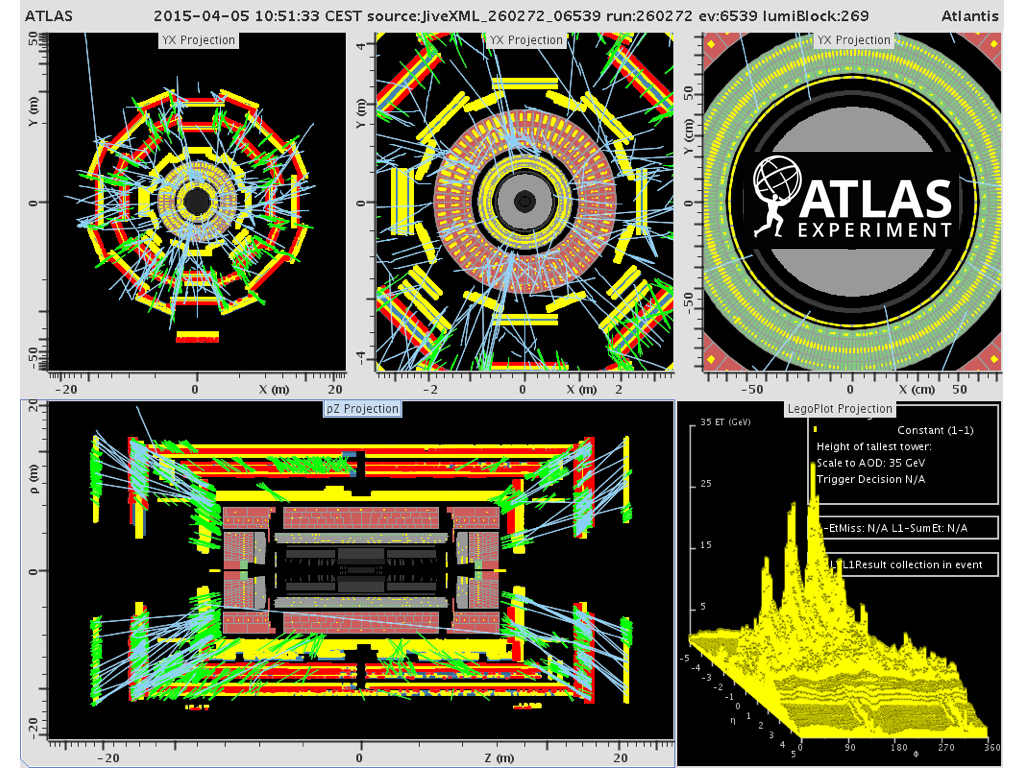
  • The LHC has seen collisions at injection energy, 450 GeV per beam. There's a little more you can read at symmetry magazine; still plenty of calibration to be done. Here's one of the events in the ATLAS detector, a far cry from the messy environment we'll see at 13 TeV...


    As well, CMS has a visualisation of one of their events on YouTube.
  • Pheno 2015 happened this week in Pittsburgh. Definitely worth perusing the interesting talks on the indico page.
  • I uploaded an arXiv preprint on Monday, "Constraining portals with displaced Higgs decay searches at the LHC." One of the primary purposes of the LHC is to study the properties of the newly discovered Higgs boson in great detail. Even though we have now measured its mass to within ~0.2%, it is still possible that it is decaying to exotic particles 20% of the time! So it is clearly sensible to search for exotic Higgs decays. I concentrated on one possibility: the decay to a pair of long-lived particles which each subsequently decay around 1 metre from the beam pipe...

    Such long-lived particles are well-motivated; typically all you need is an approximate symmetry (which is by definition technically natural à la 't Hooft) in your model which if exact would result in a stable particle. This appears to be coming into vogue at the moment as we see natural SUSY being pushed into compressed and long-lived areas of parameter space; for example, if you violate R-parity just slightly then the would-be neutralino dark matter candidate can become long-lived. I became interested in this sort of phenomenology from a much simpler standard model (SM) extension: by a real singlet scalar field $S$. In that case you can write down a potential term $\zeta \phi^\dagger\phi S^2$ which mixes the Higgs boson and a new mass eigenstate $s$ after symmetry breaking. As $\zeta\to 0$ the $S$ field decouples from the SM and becomes stable, so for small $\zeta$ it is long-lived. It is possible that the $S$ also directly couples to some dark sector uncharged under the SM forces, so-called Higgs portal models. Anyway, the Higgs we know and love can decay to two $s$ particles which, in the simplest case, decay to SM particles somewhere in the middle of the detector. Else the $s$ could have some complex cascade decay into hidden sector states which subsequently decay in the middle of the detector (often called hidden valley models).

    You can do a similar thing with a massive dark photon, the so-called vector portal. In fact, the possibilities are many and varied, which presents two complementary challenges: how do collaborations present their results in the most model-independent way possible? and how do phenomenologists reinterpret the results in the context of their own models? The point of my paper was to explore these questions...

    So I had a go at reinterpreting two searches already performed by ATLAS, in a very simple way: by running Monte Carlo simulations, calculating decay probabilities, and folding in the provided particle reconstruction efficiencies as a function of the decay distance of the long-lived particles. As phenomenologists we are reliant upon these provided efficiencies, as there is no tool available to reliably calculate them ourselves. As we move on the journey which constitutes the bulk of the paper, we learn some valuable life lessons about what efficiency table information the collaborations could provide to make the life of phenomenologists wanting to reinterpret their searches (and there are a few of us out there!) much easier. Those life lessons are summarised in the conclusion.

    As well, at the end of the day I was able to make my own contribution to the portal model exclusion space, with the pretty pictures below...


  • There's an article at Nautilus on "The Admiral of the String Theory Wars" AKA Peter Woit. As might be intuited, the article describes the string theory wars around the time when Woit released his book, "Not Even Wrong." It touches on his arXiv trackback controversy and feud with Polchinski. (Also I learned that Motl once compared Woit to bin Laden...). Woit said a few words about the article on his blog. There is also some discussion there on the following...
  • You should be able to find Amanda Peet's hour long Perimeter Institute public lecture on string theory on YouTube within a day or so.

Saturday, 18 April 2015

Friday wrap-up: 6.5 TeV, AMS, young pulsars, dark matter...

Wherein I list some (mostly) recent happenings, ramble a bit, and provide links, in an order roughly determined by importance and relevance to particle physics. Views are my own. Content very definitely skewed by my own leanings and by papers getting coverage, and it may not even be correct. It is a blog after all...

  • On this day last week we had the first 6.5 TeV beam fly around the LHC, and a day later we had both beams at once. You can read a little more at symmetry magazine.


  • AMS have presented their results on the cosmic ray proton/helium/lithium flux and the antiproton-proton ratio at a CERN mini-conference. Recordings of the talks are here and slides here. The press release is here. The plot they are pushing is the following one:

    Figure 1. Antiproton to proton ratio measured by AMS. As seen, the measured ratio cannot be explained by existing models of secondary production.

    The claim in the press release is, "This behavior cannot be explained by secondary production of antiprotons from ordinary cosmic ray collisions," with the suggestion that a new primary source(s) may be needed. But Sam Ting made sure during his talk to emphasise that it cannot be explained by existing secondary production models, and when presenting this figure he noted that there are many secondary production models, but "this is the one we choose" -- I wonder why... (an aside: he also in the same talk referred to his $J/\psi$ particle first as $J$ and then as $\psi$ on the same slide!). The point is that these models are very uncertain and the claim in the press release is unfounded. Indeed, there was a preprint on hep-ph yesterday which had the following to say: "Our first and main result is that there is no unambiguous antiproton excess that can be identified in the first place, and thus, at this stage, no real need for primary sources of antiprotons. Within errors, secondary astrophysical production alone can account for the data." Their Figure 2:


    So, don't believe the hype.
  • There was an arXiv preprint on Wednesday suggesting that young pulsars can explain the galactic centre excess. Their money plot is the following comparison of the expected dark matter spectrum with that from a prototypical young pulsar (Geminga).


  • Spectroscopic measurements of Reticulum II (here, here, and here) confirm it is an ultra-faint dwarf galaxy. Recall from the Hooper paper on the observed gamma ray excess, "In order for this excess to be compatible with the lack of significant gamma-ray detections from other dwarf galaxies... Reticulum II must contain a high density of dark matter, corresponding to $J \gtrsim 10^{19.6}\text{ GeV}^2/\text{cm}^{-5}$." One the new preprints has the J-factor measured at $10^{18.8\pm0.6}\text{ GeV}^2/\text{cm}^{-5}$ within 0.2 degs, and $10^{18.9\pm0.6}\text{ GeV}^2/\text{cm}^{-5}$ within 0.5 degs, and another has it at $10^{19.5^{+1.0(+1.6)}_{−0.6(−1.3)}}\text{ GeV}^2/\text{cm}^{-5}$ within 0.5 degs. So measurements seem to be disfavouring a dark matter interpretation. Also, it is of note that there is a radio source (likely a blazar) located 0.1 degs from the Ret II location which could be responsible for excess gamma rays...
  • An arXiv preprint (press release here) has observed that, in a system of four colliding elliptical galaxies, "each of the central galaxies retains a dark matter halo, but that (at least) one of these is spatially offset from its stars." The abstract adds, "With such a small physical separation, it is difficult to definitively rule out astrophysical effects operating exclusively in dense cluster core environments – but if interpreted solely as evidence for self-interacting dark matter, this offset implies a cross-section $\sigma_{DM}/m \sim (1.7\pm0.7)\times10^{−4} \text{ cm}^2/\text{g}\times(t_{infall}/10^9\text{yrs})^{−2}$, where $t_{infall}$ is the infall duration."

    We should keep in mind that these limits are based on the assumption that the interaction is velocity-independent, which is not true of a low-mass mediator. I don't have anything illuminating to add, but I do find it interesting that the previous study of colliding galaxy clusters set an upper limit of $\sigma_{DM}/m < 0.47 \text{ cm}^2/\text{g}$, and this measurement is almost four orders of magnitude smaller! Are measurements of these kinds of systems that much more sensitive? Why doesn't this system set an even stronger upper limit?
  • The "Evidence for dark matter in the inner Milky Way" saga appears to have reached an end. Both the comment and the reply to comment were updated this week, with the former reproducing a plot from a 1988 paper which is "in essence, identical to that of Iocco et al," and the latter writing, "In our letter we made a claim based on a specific technical point: that current data are constraining enough to make the claim robust against statistical and systematic errors. We believe we have made this point clear with our letter and two replies, and we shall not continue the discussion on the arXiv."
  • The Dark Energy Survey has produced a dark matter map (arXiv here, nature article here) of part of our sky using graviational lensing. Below is a heat map showing the mass density along with locations of galaxy clusters superimposed as grey dots. The map supports the standard picture that dark matter drives large-scale structure formation.

    photo
  • The EPS HEPP prizes were given out this week; the main prize went to James D. Bjorken “for his prediction of scaling behaviour in the structure of the proton that led to a new understanding of the strong interaction”, and to Guido Altarelli, Yuri L. Dokshitzer, Lev Lipatov, and Giorgio Parisi “for developing a probabilistic field theory framework for the dynamics of quarks and gluons, enabling a quantitative understanding of high-energy collisions involving hadrons”.
  • Strassler has been tackling the issue of dark matter searches at the LHC this week. He has a blog post and a new article for the layman.
  • Paul Jackson has written a blog post for the ATLAS blog on CoEPP and our conference in February.
  • Our understanding of the particle zoo as a function of time at Scientific American.
  • Frank Wilczek has a new book coming out in July, "A Beautiful Question: Finding Nature’s Deep Design."
  • Lastly, space images...
    • The first colour image of Pluto (and Charon) from New Horizons:

    • And here is our first view of Ceres from Dawn's new address:

      Ceres' North Pole

Friday, 10 April 2015

Friday wrap-up: LHC first beam, mono-Z'...

Wherein I list some (mostly) recent happenings, ramble a bit, and provide links, in an order roughly determined by importance and relevance to particle physics. Views are my own. Content very definitely skewed by my own leanings and by papers getting coverage, and it may not even be correct. It is a blog after all...

  • Protons circulated the LHC for the first time since long shutdown last Sunday! If you want to relive the day you can read backwards through the live blog. Beams circled both ways (first Beam 2 [anticlockwise] then Beam 1) at the injection energy of 450 GeV, after the collimators placed along the way were each opened up in turn. For ATLAS and CMS the collimators placed ~100m away created some spectacular beam splash events. Below are the first recorded splash events from CMS and from ATLAS.


    Images from the day can be found here, and you can check the current LHC status here (or a more detailed status here). Since then there have been a bunch of technical tests and splashes. There's also an article from CERN about the plan up until collisions. In the immediate future we wait for both beams to ramp-up to 6.5 TeV. The magnets are trained and ready as of Saturday, and first probe beam reached 6.5 TeV this morning...


  • An interesting observation which Strassler brought up, and I have noticed as well: there is much more talk about dark matter as a goal for LHC Run II, in lieu SUSY. The CERN press release wrote, "The Brout-Englert-Higgs mechanism, dark matter, antimatter and quark-gluon plasma are all on the menu for LHC season 2," and Nature wrote, "In 2012, more than two years after the machine first started up, LHC experiments found the long-awaited Higgs boson... The second run does not have such an obvious target. Instead, physicists will scour the data for signs of phenomena that do not fit with the standard model of particle physics in hopes of solving mysteries such as the origins of dark matter."
  • On that (dark matter at the LHC) front, the arXiv awoke on Wednesday to a new mono-X, i.e. these-three-preprints discussing the mono-Z'. The salient processes are the three depicted in the below diagram (where the leptons could be replaced by jets, or a thin jet if the Z' is light and boosted), plus dark Higgs-strahlung.


    It's a sensible thing to go and look for, and I'm surprised it's taken so long to be looked at in a general context... though obviously it was high time! Now inviting speculation on the next mono-X... mono-W'? mono-stoponium? neutrinoless mono-beta decay?
  • Lastly, as is the tradition, a space image... here is a gravitationally lensed galaxy nearly 12 billion light-years away, imaged by ALMA.

Friday, 3 April 2015

Friday wrap-up: LHC restart, dark photon, a drama in five acts...

Wherein I list some (mostly) recent happenings, ramble a bit, and provide links, in an order roughly determined by importance and relevance to particle physics. Views are my own. Content very definitely skewed by my own leanings and by papers getting coverage, and it may not even be correct. It is a blog after all...

  • On the LHC restart, the short circuit was fixed on Monday by melting the offending metal fragment with an injection of 400 amps of current for a few milliseconds. Now the news is that "first beams could be circulating in the machine sometime between Saturday and Monday... Particle collisions at an energy of 13 TeV could start as early as June." 
  • The NA48/2 Collaboration has submitted their search for the dark photon in $\pi^0\to \gamma A'$ decays, ruling out the remaining parameter space for the dark photon as an explanation for the muon $(g-2)$ anomaly.


  • On the 'Evidence for dark matter in the inner Milky Way' front, we now have a 'Reply to Comment on "Evidence for dark matter in the inner Milky Way."' Will we see a 'Comment on "Reply to Comment on "Evidence for dark matter in the inner Milky Way"'? Stay tuned... 
  • In a blog post from Tim Head, it turns out that machine learning can do pretty well at telling the difference between interesting and uninteresting papers on the arXiv, using only the title and abstract as input.
  • Arkani-Hamed and Maldacena had a preprint out on Monday: "Cosmological Collider Physics." The paper is about how we might recognise the presence of new particles with inflaton interactions by their impact on primordial cosmological fluctuations. It is quite long (49+12 pages) and far outside my area, so I will leave it at that... I wonder if Tim Head's algorithm would classify the paper as interesting?
  • NPR ran a story on the CRAYFIS project aimed at detecting high-energy cosmic rays with a network of smartphones, bringing >7000 people to the service.
  • An arXiv preprint from Melbourne CoEPP and collaborators has pointed out that ATLAS and CMS have been led by theorists to perform searches for an unphysical dark matter EFT. To quote from the paper:

    As an example of a problem encountered with an $SU(2)_L$ violating EFT, consider the following operator:$$\frac{1}{\Lambda^2}(\overline{\chi}\gamma^\mu \chi)(\overline{u}\gamma_\mu u+\xi\overline{d}\gamma_\mu d)$$This Lagrangian violates $SU(2)_L$, unless $\xi=1$. The case of unequal $u$ and $d$ couplings was considered in Ref. [13], where a very strong constructive(destructive) “interference effect” was found for $\xi=-1(+1)$, the degree of which depends on the energy scale. The analysis of Ref. [13] was subsequently repeated by the LHC experimental collaborations ATLAS [14, 15] and CMS [16, 17]. We shall demonstrate that the large cross section enhancement for $\xi=+1$ is in fact due the production of longitudinally polarized W’s as a result of breaking gauge invariance.
  • APS has spotlighted some lattice QCD results from investigators including CoEPP Adelaide node members which indicate that the Λ(1405) resonance has a molecular quark pair+triplet structure (arXiv version).
  • Scientific American has a story on dark matter and the dinosaurs, inspired by the Rampino paper from February. They are refreshingly skeptical, and they mention the work of Randall-Reece and Abbas-Abbas, which was my main problem with prior articles -- overall a nice piece of science journalism!
  • In video/audio media
  • I have only seen one April Fools' arXiv article making the rounds this week: A Farewell to Falsifiability. From the abstract, "... some far-thinking physicists have proposed instead that we should give up on the notion of Falsifiability itself. We endorse this suggestion but think it does not go nearly far enough. We believe that we should also dispense with other outdated ideas, such as Fidelity, Frugality, Factuality and other "F" words. And we quote a lot of famous people to support this view." There is some discussion on Peter Woit's blog as to whether this article from Ashoke Sen (Milner Prize winner) is also to be taken as an April Fools' submission, or just some pop-sci...
  • This week I became aware of a 1979 document on the CERN server from Ellis et al. called "Can one tell QCD from a hole in the ground? : a drama in five acts." It is indeed a drama in five acts, about QCD, with illustrations and figures!


  • Lastly, some loosely science-related images from the week...

    Here is a photo from César Cantú of lightning in the ash cloud of Mexico's Colima volcano (hat-tip Bad Astronomy).

    IMG_0360 2400x1600.jpg

    Typhoon Maysak from Samantha Cristoforetti on the International Space Station.